
|
|
|
| synonym |
Limotettix cuneatus |
| description |
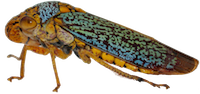
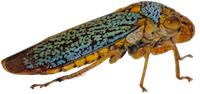
A small greenish-yellow species. The vertex is almost parallel margined, slightly and roundedly produced with a bold, thick black transverse band between the eyes, behind the ocelli. The wings are noticeably longer than the abdomen and are a smoky subhyaline color with yellowish nervures. The female pregenital sternite has prominent lateral angles, with the posterior margin strongly produced on either side of a dark median obtuse tooth. The male subgenital plates are long, tapering gradually to acute tips. Adults are 3.0-3.5 mm long. (DeLong 1948)
For diagrams of this species, including the vertex pattern, see: 3I. For images of specimens of this species, see: BOLD. |
| distribution |
Eastern United States and Canada; also California (3I) |
| abundance |
Recorded from the state, but unclear from where. |
| seasonal_occurrence | |
| habitat |
Has been collected from lagoon margins, boggy areas, wet meadows, swamps, and wet pastures (Chandler & Hamilton 2017). |
| plant associates |
Flatsedge (Cyperus spp.) and rushes (Juncus spp.; DeLong 1948, Chandler & Hamilton 2017) |
| behavior |
|
| comments |
NOTE: Some authors treat Ophiola, Ophiolix, and Scleroracus as distinct genera, while other authors treat these as subgenera within Limotettix. More work needs to be done to verify these distinctions/determine the borders of each genus (J. Kits pers. comment). For now, we will follow the latest treatment used in the World Auchenorrhyncha Database (3I). |
status |
[Native:]
[Introduced:]
[Extirpated:] | | list_type |
[Official:]
[Provisional:] |
| adult_id | Unmistakable and widely known Identifiable from good quality photos of unworn specimens
Identifiable from photos showing undersides, or other specialized views [e.g., legs, face]
Identifiable only by close inspection of structural features or by DNA analysis NULL |
| nymph_id | Unmistakable and widely known Identifiable from good quality photos, especially where associated with known host plants
Identifiable from close inspection of specimens or by DNA analysis
Identifiable only through rearing to adulthood NULL |
| G_rank |
|
| S_rank |
|
| rank_comments |
|
| tribe |
Limotettigini |
| subgenus |
|

 »
»