
|
|
|
| synonym |
Limotettix angustatus |
| description |
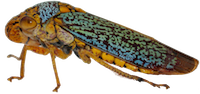
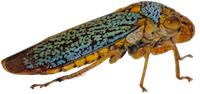
Greenish yellow to brownish, an overall dark species. The vertex is broadly rounded, more than twice as wide between the eyes as the median length. There are irregular blackish markings covering most of the vertex; the pronotum and scutellum are also mostly dark. The wing nervures are pale, bordered with fuscous coloration; the wings are a dark smoky subhyaline. The female pregenital sternite is almost truncate on the posterior margin, with a near-straight posterior margin; the lateral angles very blunt. The male subgenital plates are triangular and slightly concave on the apical halves, with the apices acutely pointed. Adults are 4 mm long. (DeLong 1948)
For diagrams of this species including the thoracic and head pattern, see: 3I. For images of some pinned specimens, see: BOLD. |
| distribution |
Eastern and central United States, transcontinental across Canada (3I) |
| abundance |
Recorded from the mountains. |
| seasonal_occurrence | |
| habitat |
Found in bogs (Hamilton 1994) |
| plant associates |
Rushes and sedges (Chandler & Hamilton 2017) |
| behavior |
|
| comments |
NOTE: Some authors treat Ophiola, Ophiolix, and Scleroracus as distinct genera, while other authors treat these as subgenera within Limotettix. More work needs to be done to verify these distinctions/determine the borders of each genus (J. Kits pers. comment). For now, we will follow the latest treatment used in the World Auchenorrhyncha Database (3I). |
status |
[Native:]
[Introduced:]
[Extirpated:] | | list_type |
[Official:]
[Provisional:] |
| adult_id | Unmistakable and widely known Identifiable from good quality photos of unworn specimens
Identifiable from photos showing undersides, or other specialized views [e.g., legs, face]
Identifiable only by close inspection of structural features or by DNA analysis NULL |
| nymph_id | Unmistakable and widely known Identifiable from good quality photos, especially where associated with known host plants
Identifiable from close inspection of specimens or by DNA analysis
Identifiable only through rearing to adulthood NULL |
| G_rank |
|
| S_rank |
|
| rank_comments |
|
| tribe |
Limotettigini |
| subgenus |
|

 »
»