
|
|
|
| synonym |
|
| description |
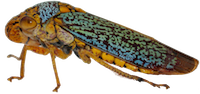
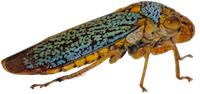
A fairly distinctive species due to the contrasting yellowish and black coloration on the body and wings. The vertex is blackish, varying in extent of black from either the anterior portion between the ocelli to largely the entire vertex. The vertex is strongly produced and sharply angled, being one-fourth longer in the middle than the width between the eyes. The pronotum is one-third shorter than the vertex and more than twice as wide as long. The wings only cover the two basal segment of the abdomen (leaving 6-7 abdominal segments visible), giving this species a short-winged, brachypterous appearance; no macropterous forms are known. The wings are yellowish to yellowish-orange and unmarked, with concolorous veins, contrasting with an abdomen that is usually black. Pale individuals of the variety "melleus" can have an abdomen that is largely concolorous with the wings, with the penultimate segment black. The underside, including the abdomen, legs, and face, varies in color from stramineous to fuscous/black. The female pregenital sternite has a rather deep notch on each side of a central, broadly rounded lobe with a small notch in the middle. The male subgenital plates are narrow, triangular, and elongate, narrowing concavely toward the apices. Adult males are 2.8 to 3.1 mm long, while females are 3.0-3.4 mm. (DeLong 1926, Kramer 1967)
For images and diagrams of this species, see: 3I. |
| distribution |
Southeastern United States, from North Carolina to Louisiana (3I) |
| abundance |
A single record from the Coastal Plain. |
| seasonal_occurrence | |
| habitat |
Grassy fields, prairies and pine savannah habitat (DeLong, 1926) |
| plant associates |
Small grasses, such as bog-buttons (Lachnocanlon anceps) (DeLong 1926, Kramer 1967) |
| behavior |
|
| comments |
|
status |
[Native:]
[Introduced:]
[Extirpated:] | | list_type |
[Official:]
[Provisional:] |
| adult_id | Unmistakable and widely known Identifiable from good quality photos of unworn specimens
Identifiable from photos showing undersides, or other specialized views [e.g., legs, face]
Identifiable only by close inspection of structural features or by DNA analysis NULL |
| nymph_id | Unmistakable and widely known Identifiable from good quality photos, especially where associated with known host plants
Identifiable from close inspection of specimens or by DNA analysis
Identifiable only through rearing to adulthood NULL |
| G_rank |
|
| S_rank |
|
| rank_comments |
|
| tribe |
Deltocephalini |
| subgenus |
|

 »
»