|
|
|
| synonym |
|
| description |
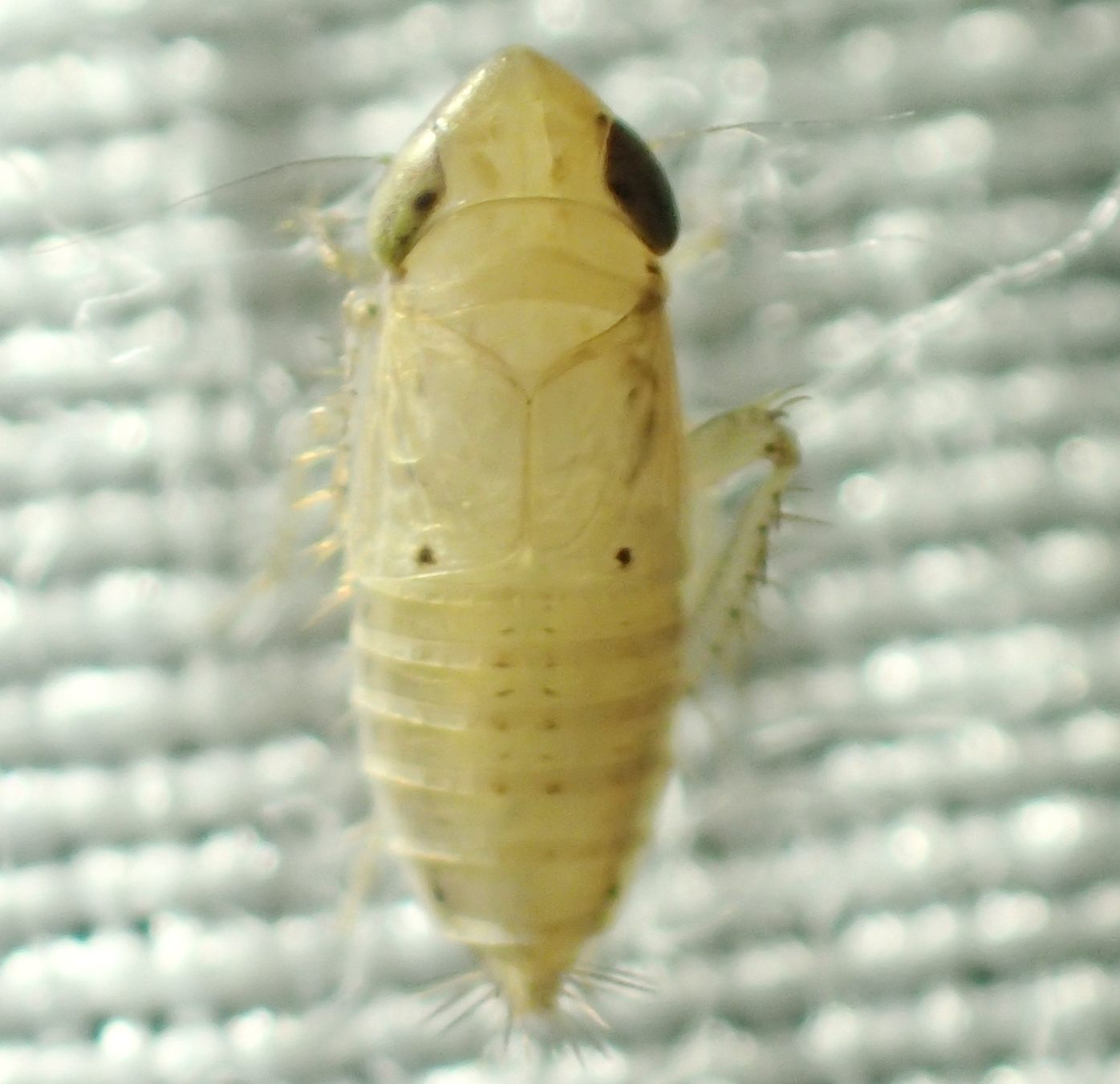
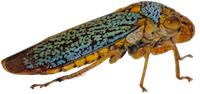
A pale brown to yellowish species that is distinctly marked with brown spots, usually in pairs, on the pronotum, scutellum, and wings; in pale or teneral individuals, some of the spots may be indistinct or absent. The vertex is only slightly longer in the middle than the width between the eyes, and is bluntly angled. The vertex is mottled with darker brown, but not striped, and in well-marked individuals there are three pairs of darker marks on the median portion. There are typically four other pairs of dark spots that are conspicuous: a proximal pair towards the anterior margin of the pronotum (behind the eyes), a pair in the basal angles of the scutellum, one on the middle of each claval suture, and another on the basal portion of the inner ante-apical cell of each wing. The dorsal portion of the exposed abdomen ranges from being unmarked to marked with pairs of spots. In brachypterous forms, the wings cover only the first two dorsal segments; in macropterous forms, the wings cover the first seven segments. The thoracic venter, legs, and face are stramineous to light brown; sometimes the legs are marked with darker brown spots or transverse bands. The female pregenital sternite has a posterior margin that is slightly emarginate with a broad, produced median tooth that is slightly notched at the apex. The male subgenital plates are only one-third as long as the last ventral segment and together about half as wide; they are triangular with blunt tips. Adult males are 3.5-3.9 mm long, while females are 3.7-4.2 mm. (DeLong 1926, Kramer 1967) |
| distribution |
Southeastern United States, from North Carolina to Mississippi (3I) |
| abundance |
A couple records from a single county along the Coast, likely more abundant in the right habitat. |
| seasonal_occurrence | |
| habitat |
Grassy fields, prairies and open pine woodland habitat (DeLong, 1926) |
| plant associates |
Short grasses, such as star rush (Dichromena floridensis), beak rush (Rhynchospora divergens), and sea shore saltgrass (Distichlis spicata) (DeLong 1926, Kramer 1967) |
| behavior |
Can be attracted at night with a light. |
| comments |
|
status |
[Native:]
[Introduced:]
[Extirpated:] | | list_type |
[Official:]
[Provisional:] |
| adult_id | Unmistakable and widely known Identifiable from good quality photos of unworn specimens
Identifiable from photos showing undersides, or other specialized views [e.g., legs, face]
Identifiable only by close inspection of structural features or by DNA analysis NULL |
| nymph_id | Unmistakable and widely known Identifiable from good quality photos, especially where associated with known host plants
Identifiable from close inspection of specimens or by DNA analysis
Identifiable only through rearing to adulthood NULL |
| G_rank |
|
| S_rank |
|
| rank_comments |
|
| tribe |
Deltocephalini |
| subgenus |
|
Species Photo Gallery for Lonatura notata No Common Name |
 | Photo by: Erich Hofmann, David George, Rich Teper, Jeff Niznik
New Hanover Co.
Comment: Lonatura notata - https://www.inaturalist.org/observations/163290948rnrnAttracted to moth light - unid_leafhopper |  | Photo by: Erich Hofmann, David George, Rich Teper, Jeff Niznik
New Hanover Co.
Comment: https://www.inaturalist.org/observations/163290948; Attracted to moth light |
|

 »
»