Moths of North Carolina
Scientific Name:
Common Name:
Family (Alpha):
« Home »
View PDFScythrididae Members: Scythris Members: 3 NC Records

Scythris sinensis (Felder & Rogenhofer, 1875) - No Common Name


Scythris sinensis
Taxonomy
Family:
Scythrididae
P3 Number:
59a1720
MONA Number:
1651.10
Comments: The genus Scythris is a member of the Family Scythrididae, whose members display a diversity of genital structures that is probably unsurpassed within any other family in the Lepidoptera (Landry, 1991). The extraordinarily diversity in genital morphology in the males of many taxa reaches such extremes that it is easy to recognize species, but difficult to delineate higher taxa. There are around 44 currently recognized species for the Nearctic region. North America has 14 described species, including 10 species of Scythris. Most are drably colored moths that superficially resemble one another. Landry (1991) found at least 300 undescribed species in North American collections alone based on genitalic differences, and estimated that there could be as many as 400 and 500 species of scythridids In North America. Many of these are in arid regions of the US.
Identification
Field Guide Descriptions: Online Resources: MPG, BugGuide, iNaturalist, Google, BAMONA, GBIF, BOLD                                                                                 
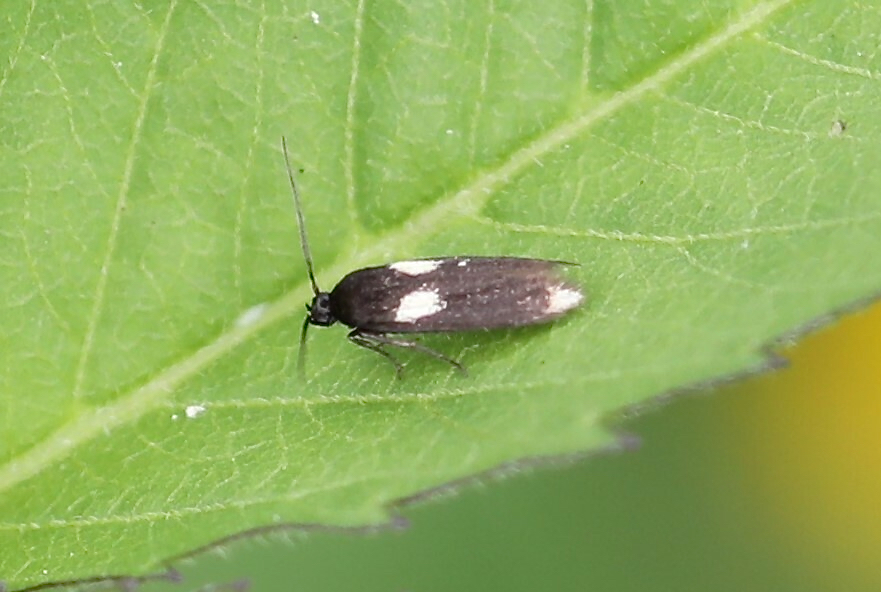
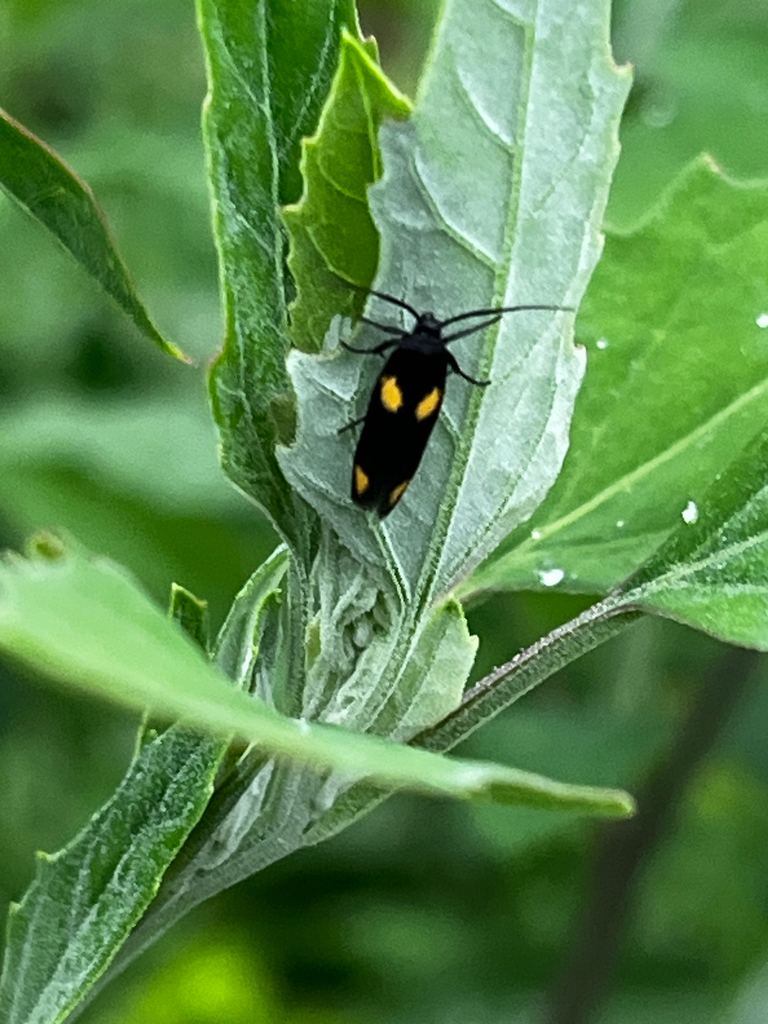
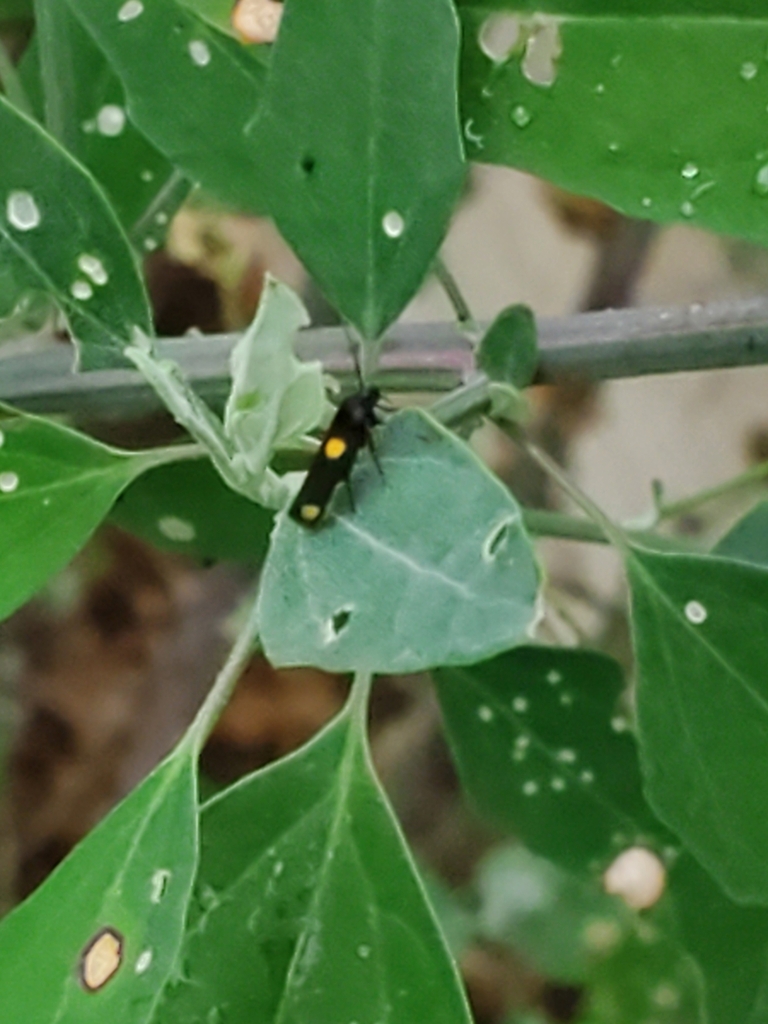
Adult Markings: Scythris sinensis is an introduced species that in native to Asia and the East Palearctic, but has since spread to Europe and North America. The adults are easily recognized by their largely purplish-black bodies, except for a bright orange abdomen and two sharp orange or bright yellow spots, with one at around one-fourth the wing length from the base and the other near the outer margin. The spots can be completely absent in specimens of the spring generation, but present in the summer generation (Sattler l97l). As of 2025, we have a cluster of records from the north-central Piedmont.
Adult ID Requirements: Identifiable from good quality photos of unworn specimens.
Larvae ID Requirements: Identifiable only through rearing to adulthood.
Distribution in North Carolina
Distribution: Scythris sinensis is native to Asia and the East Palearctic, but is now common in Europe and the eastern US. It was first discovered in the US in Pennsylvania in 2011 (Landry et al., 2013), and has since rapidly spread to many other states. As of 2025, it has been documented from Minnesota, Iowa and Nebraska eastward to the New England states, and southward to southern Illinois, Kentucky, Virginia and North Carolina. There are also records from Ontario and Quebec, and at least one record from Oregon.
County Map: Clicking on a county returns the records for the species in that county.
Scythris sinensisAlamance Alexander Alleghany Anson Ashe Avery Beaufort Bertie Bladen Brunswick Buncombe Burke Cabarrus Caldwell Camden Carteret Caswell Catawba Chatham Cherokee Chowan Clay Cleveland Columbus Craven Cumberland Currituck Dare Davidson Davie Duplin Durham Edgecombe Forsyth Franklin Gaston Gates Graham Granville Greene Guilford Halifax Harnett Haywood Henderson Hertford Hoke Hyde Iredell Jackson Johnston Jones Lee Lenoir Lincoln Macon Madison Martin McDowell Mecklenburg Mitchell Montgomery Moore Nash New Hanover Northampton Onslow Orange Pamlico Pasquotank Pender Perquimans Person Pitt Polk Randolph Richmond Robeson Rockingham Rowan Rutherford Sampson Scotland Stanly Stokes Surry Swain Transylvania Tyrrell Union Vance Wake Warren Washington Watauga Wayne Wilkes Wilson Yadkin Yancey
Flight Dates:
High Mountains (HM) ≥ 4,000 ft.
Low Mountains (LM) < 4,000 ft.
Piedmont (Pd)
Coastal Plain (CP)

Click on graph to enlarge
Image showing flight dates by month for High Mountains greater than 4,000 feet, Low Mountains, Piedmont, and Coastal Plain: adults.
Habitats and Life History
Habitats: This species is commonly found in urban and rural settings in disturbed habitats.
Larval Host Plants: Larvae feed on members of the Chenopodiaceae, including Spear Saltbush (Atriplex patula) and Lamb's-quarters (Chenopodium album). Both of these are widespread introduced weeds in North America (Landry et al., 2013). - View
Wikipedia
Status in North Carolina
Natural Heritage Program Status:
Natural Heritage Program Ranks:
State Protection:
Comments: This is an introduced species that feeds on another introduced species and is not of conservation concern.

 Photo Gallery for Scythris sinensis - None

Photos: 2
Scythris sinensis
iNaturalist
Recorded by: kylegeraghty - Kyle Geraghty on 2025-06-28
Iredell Co.
Comment: iNat record - https://www.inaturalist.org/observations/295398098***(c) Kyle Geraghty, all rights reserved| Public Positional Accuracy=9 m Elevation=866.3 feet
Scythris sinensis
Recorded by: Rob Van Epps on 2022-07-16
Yadkin Co.
Comment: iNat: Photo 214774008; Creative Commons (CC BY-NC 4.0 DEED)

Photos of Scythris sinensis from iNaturalist

Scythris sinensis
© poikilos - Anakin Poikilos - 2024-08-02 - Stokes Co.
iNat record
Scythris sinensis
© kylegeraghty - Kyle Geraghty - 2025-06-28 - Iredell Co.
iNat record