Moths of North Carolina
Home Page
Recent Entries
Recent Account Updates
County Searches
General Search
Submit a Public Record
Larval Hosts
References
Maps
Draft Checklists
Family Photo Gallery
Family PDFs
NC Biodiversity Project
Comments
Significant Contributors
Scientific Name:
Common Name:
Family (Alpha):
Choose a Family
ACROLEPIIDAE-False Diamondback Moths
ADELIDAE-Fairy moths
ALUCITIDAE-Many-plumed Moths
AMPHISBATIDAE-
ARGYRESTHIIDAE-Shiny Head-standing Moths
AUTOSTICHIDAE-Autostichid Moths
BATRACHEDRIDAE-Batrachedrid Moths
BEDELLIIDAE-Bedelliid Moths
BLASTOBASIDAE-Blastobasid Moths
BOMBYCIDAE-Silkworm Moths
BUCCULATRICIDAE-Ribbed Cocoon-maker Moths
CARPOSINIDAE-Fruitworm Moths
CHOREUTIDAE-Metalmark Moths
COLEOPHORIDAE-Casebearer Moths and Relatives
COSMOPTERIGIDAE-Cosmopterigid Moths
COSSIDAE-Carpenter Moths, Goat Moths
CRAMBIDAE-Grass Moths, Snout Moths
DEPRESSARIIDAE-
DREPANIDAE-Hook-tips and Thyatirid Moths
DRYADAULIDAE-
ELACHISTIDAE-Grassminer Moths and Relatives
EPERMENIIDAE-Fringe-tufted Moths
EPIPYROPIDAE-Planthopper Parasite Moths
EREBIDAE-Erebid Moths
ERIOCRANIIDAE-Eriocraniid Moths
EUTELIIDAE-Euteliid Moths
GALACTICIDAE-Galacticid Moths
GELECHIIDAE-Gelechiid Moths; Twirler Moths
GEOMETRIDAE-Geometer Moths, Loopers
GLYPHIDOCERIDAE-Glyphidocerid Moths
GLYPHIPTERIGIDAE-Sedge Moths
GRACILLARIIDAE-Leafblotch miner moths
HELIOZELIDAE-Shield bearer moths
HEPIALIDAE-Ghost or Swift Moths
HYBLAEIDAE-
INCURVARIIDAE-Leafcutter Moths
LASIOCAMPIDAE-Tent Caterpillar Moths, Lappet Moths
LECITHOCERIDAE-Long-horned Moths
LIMACODIDAE-Slug Caterpillar Moths
LIMOCODIDAE-
LYONETIIDAE-Lyonetiid Moths
MEGALOPYGIDAE-Flannel Moths
MICROPTERIGIDAE-Mandibulate Moths
MIMALLONIDAE-
MOMPHIDAE-Mompha Moths
NEPTICULIDAE-Minute leaf miners
NOCTUIDAE-Owlet Moths
NOLIDAE-
NOTODONTIDAE-Prominents
OECOPHORIDAE-Oecophorid Moths
OPOSTEGIDAE-
PELEOPODIDAE-
PLUTELLIDAE-Diamondback Moths
PRODOXIDAE-Yucca Moths
PSYCHIDAE-Bagworm Moths
PTEROPHORIDAE-Plume Moths
PYRALIDAE-Pyralid Moths, Snout Moths
SATURNIIDAE-Giant Silkworm Moths
SCHRECKENSTEINIIDAE-Schreckensteiniid Moths
SCYTHRIDIDAE-
SESIIDAE-Clearwing Moths
SPHINGIDAE-Sphinx Moths
THYATIRIDAE-
THYRIDIDAE-Window-winged Moths
TINEIDAE-Clothes moths
TISCHERIIDAE-Tischerid Moths
TORTRICIDAE-Leafroller Moths
URANIIDAE-
URODIDAE-Urodid Moths
XYLORYCTIDAE-
YPONOMEUTIDAE-Ermine Moths
YPSOLOPHIDAE-Ypsolophid Moths
ZYGAENIDAE-
«
Home
»
View
PDF
Scythrididae Members:
Landryia impositella
Scythris basilaris
Scythris charon
Scythris fuscicomella
Scythris sinensis
Scythris trivinctella
Scythris
Members:
Scythris basilaris
Scythris charon
Scythris fuscicomella
Scythris sinensis
Scythris trivinctella
1 NC Records
Scythris basilaris
(Zeller, 1855) - No Common Name
Taxonomy
Superfamily:
Gelechioidea
Family:
Scythrididae
P3 Number:
59a1703
MONA Number:
1652.00
Comments:
The genus
Scythris
is a member of the Family Scythrididae, whose members display a diversity of genital structures that is probably unsurpassed within any other family in the Lepidoptera (Landry, 1991). The extraordinarily diversity in genital morphology in the males of many taxa reaches such extremes that it is easy to recognize species, but difficult to delineate higher taxa. There are around 44 currently recognized species for the Nearctic region. North America has 14 described species, including 10 species of
Scythris
. Most are drably colored moths that superficially resemble one another. Landry (1991) found at least 300 undescribed species in North American collections alone based on genitalic differences, and estimated that there could be as many as 400 and 500 species of scythridids In North America. Many of these are in arid regions of the US.
Identification
Field Guide Descriptions:
Online Resources:
MPG
,
BugGuide
,
iNaturalist
,
Google
,
BAMONA
,
GBIF
,
BOLD
Adult Markings:
Scythris basilaris
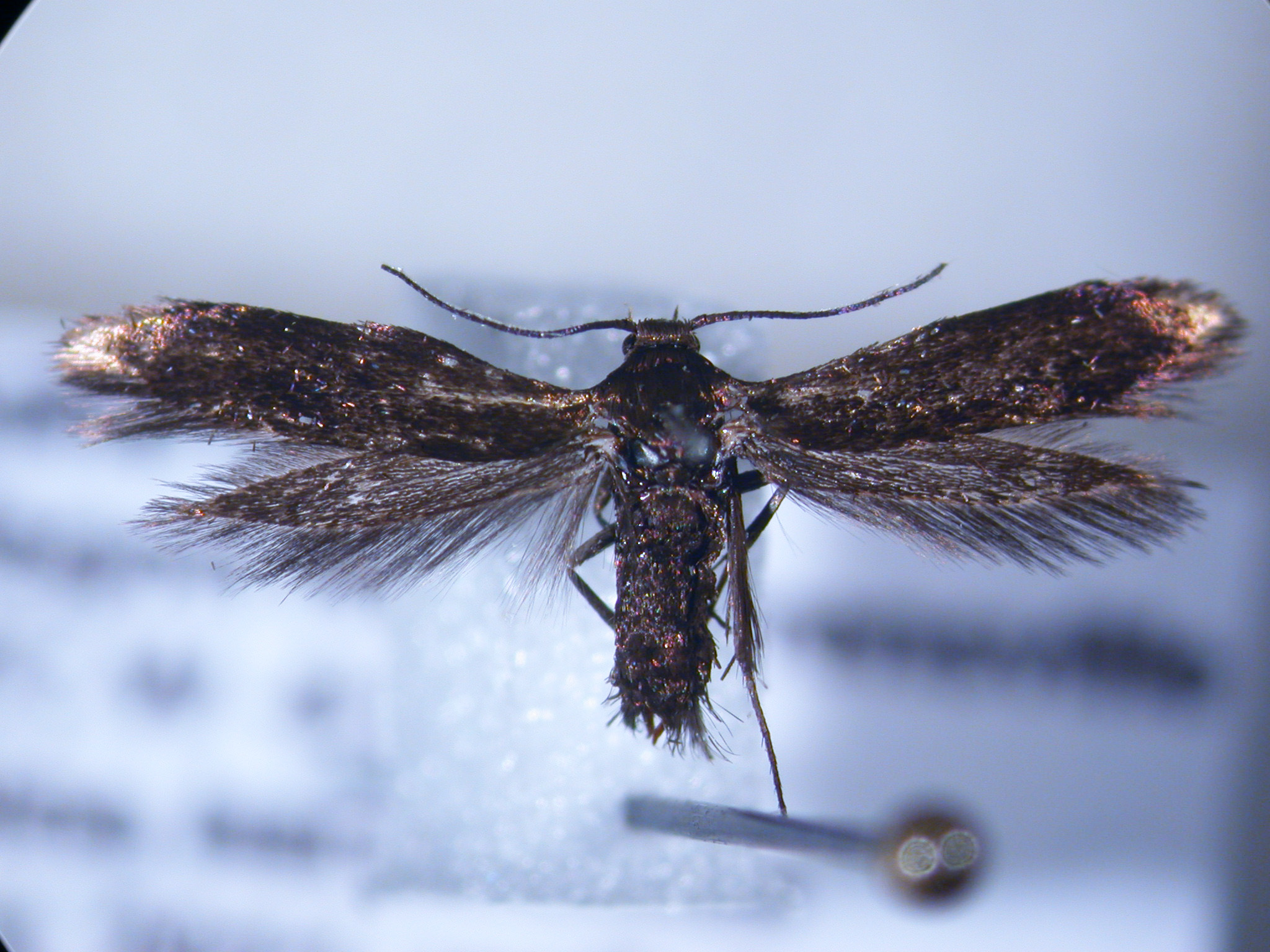
is a medium-sized scythridid with the upper surface of the body very dark brown. The forewing is dark-brown and distinctive in having a golden or yellowish streak in the fold that extends from the wing base to about one third the wing length, along with a similarly colored apical patch. The basal streak can vary from prominent to faint depending on individual variation and wear. The hind tibia also has a very long and prominent tibial brush that is characteristic of this species. In addition, the males have a dense anal tuft. The pattern of golden-yellow markings of the forewing over the dark-brown ground color distinguishes this species from those of all other Nearctic members of the Scythrididae (Landry, 1991).
Forewing Length:
5.7-6.5 mm for males and 6.0-7.0 mm for females.
Adult Structural Features:
Landry (1991) has descriptions and illustrations of the male and female genitalia.
Adult ID Requirements:
Identifiable from good quality photos of unworn specimens.
Larvae ID Requirements:
Identifiable only through rearing to adulthood.
Distribution in North Carolina
Distribution:
Scythris basilaris
is found in eastern North America and mostly in areas with cool climates, including Ontario and much of the northeastern US. The range extends from New Hampshire and Massachusetts westward across the Great Lakes region to Iowa, and southwestward mostly through the Appalachian region to West Virginia, southern Ohio, eastern Kentucky, and western North Carolina (Landry, 1991). There is one isolated record from central Florida. As of 2025, we have a single record from Ashe County.
County Map:
Clicking on a county returns the records for the species in that county.
Flight Dates:
High Mountains (HM) ≥ 4,000 ft.
Low Mountains (LM) < 4,000 ft.
Piedmont (Pd)
Coastal Plain (CP)
Click on graph to enlarge
Flight Comments:
Landry (1991) reported that the adults occur from mid-June to mid-July and are probably diurnal. As of 2025, our one record is from 7 July.
Habitats and Life History
Habitats:
Local populations are often found in forest edge habitats and open woods.
Larval Host Plants:
The host plants are poorly documented. Landry (1991) reported that two museum labels stated that this species was found on Jersey Tea (Ceanothus americanus) and a second Ceanothus species, which suggests that this might be the host plant. Robinson et al. (2010) reported that the larvae feed on blackberries (
Rubus
spp.), but we are unaware for the basis for this. As of 2025, we do not have any larval records for North Carolina. -
View
Observation Methods:
The adults are diurnally active and can sometimes be collected by sweeping low vegetation or searching for adults feeding on flowers such as Achillea or Ceanothus.
Wikipedia
Status in North Carolina
Natural Heritage Program Status:
Natural Heritage Program Ranks:
GNR [S2]
State Protection:
Comments:
This species appears to reach its southern range limit in the Blue Ridge of North Carolina where we have only one record as of 2025.
Photo Gallery for
Scythris basilaris
- None
Photos: 1
Recorded by: J.B. Sullivan on 2021-07-07
Ashe Co.
Comment:
 »
»