Moths of North Carolina
Home Page
Recent Entries
Recent Account Updates
County Searches
General Search
Submit a Public Record
Larval Hosts
References
Maps
Draft Checklists
Family Photo Gallery
Family PDFs
NC Biodiversity Project
Comments
Significant Contributors
Scientific Name:
Common Name:
Family (Alpha):
Choose a Family
ACROLEPIIDAE-False Diamondback Moths
ADELIDAE-Fairy moths
ALUCITIDAE-Many-plumed Moths
AMPHISBATIDAE-
ARGYRESTHIIDAE-Shiny Head-standing Moths
AUTOSTICHIDAE-Autostichid Moths
BATRACHEDRIDAE-Batrachedrid Moths
BEDELLIIDAE-Bedelliid Moths
BLASTOBASIDAE-Blastobasid Moths
BOMBYCIDAE-Silkworm Moths
BUCCULATRICIDAE-Ribbed Cocoon-maker Moths
CARPOSINIDAE-Fruitworm Moths
CHOREUTIDAE-Metalmark Moths
COLEOPHORIDAE-Casebearer Moths and Relatives
COSMOPTERIGIDAE-Cosmopterigid Moths
COSSIDAE-Carpenter Moths, Goat Moths
CRAMBIDAE-Grass Moths, Snout Moths
DEPRESSARIIDAE-
DREPANIDAE-Hook-tips and Thyatirid Moths
DRYADAULIDAE-
ELACHISTIDAE-Grassminer Moths and Relatives
EPERMENIIDAE-Fringe-tufted Moths
EPIPYROPIDAE-Planthopper Parasite Moths
EREBIDAE-Erebid Moths
ERIOCRANIIDAE-Eriocraniid Moths
EUTELIIDAE-Euteliid Moths
GALACTICIDAE-Galacticid Moths
GELECHIIDAE-Gelechiid Moths; Twirler Moths
GEOMETRIDAE-Geometer Moths, Loopers
GLYPHIDOCERIDAE-Glyphidocerid Moths
GLYPHIPTERIGIDAE-Sedge Moths
GRACILLARIIDAE-Leafblotch miner moths
HELIOZELIDAE-Shield bearer moths
HEPIALIDAE-Ghost or Swift Moths
HYBLAEIDAE-
INCURVARIIDAE-Leafcutter Moths
LASIOCAMPIDAE-Tent Caterpillar Moths, Lappet Moths
LECITHOCERIDAE-Long-horned Moths
LIMACODIDAE-Slug Caterpillar Moths
LIMOCODIDAE-
LYONETIIDAE-Lyonetiid Moths
MEGALOPYGIDAE-Flannel Moths
MICROPTERIGIDAE-Mandibulate Moths
MIMALLONIDAE-
MOMPHIDAE-Mompha Moths
NEPTICULIDAE-Minute leaf miners
NOCTUIDAE-Owlet Moths
NOLIDAE-
NOTODONTIDAE-Prominents
OECOPHORIDAE-Oecophorid Moths
OPOSTEGIDAE-
PELEOPODIDAE-
PLUTELLIDAE-Diamondback Moths
PRODOXIDAE-Yucca Moths
PSYCHIDAE-Bagworm Moths
PTEROPHORIDAE-Plume Moths
PYRALIDAE-Pyralid Moths, Snout Moths
SATURNIIDAE-Giant Silkworm Moths
SCHRECKENSTEINIIDAE-Schreckensteiniid Moths
SCYTHRIDIDAE-
SESIIDAE-Clearwing Moths
SPHINGIDAE-Sphinx Moths
THYATIRIDAE-
THYRIDIDAE-Window-winged Moths
TINEIDAE-Clothes moths
TISCHERIIDAE-Tischerid Moths
TORTRICIDAE-Leafroller Moths
URANIIDAE-
URODIDAE-Urodid Moths
XYLORYCTIDAE-
YPONOMEUTIDAE-Ermine Moths
YPSOLOPHIDAE-Ypsolophid Moths
ZYGAENIDAE-
«
Home
»
View
PDF
Gelechiidae Members:
Agnippe prunifoliella
Anacampsini new genus new species
Anacampsis agrimoniella
Anacampsis conclusella
Anacampsis consonella
Anacampsis coverdalella
Anacampsis fragariella
Anacampsis levipedella
Anacampsis lupinella
Anacampsis New Species 2
Anacampsis New Species one
Anacampsis rhoifructella
Anacampsis tristrigella
Anacampsis unidentified species
Anarsia lineatella
Aproaerema unidentified species
Arcutelphusa talladega
Aristotelia callirrhoda
Aristotelia fungivorella
Aristotelia isopelta
Aristotelia ivae
Aristotelia lespedezae
Aristotelia monilella
Aristotelia pudibundella
Aristotelia roseosuffusella
Aristotelia rubidella
Aristotelia unidentified species
Aroga argutiola
Aroga compositella
Aroga epigaeella
Aroga trialbamaculella
Aroga trialbamaculella complex
Aroga unidentified species
Arogalea cristifasciella
Arogalea unidentified species
Battaristis concinnusella
Battaristis new species
Battaristis nigratomella
Battaristis unidentified species
Battaristis vittella
Besciva n. sp.
Bryotropha unidentified species
Caryocolum pullatella
Chionodes adamas
Chionodes baro
Chionodes bicostomaculella
Chionodes cacula
Chionodes continuella
Chionodes dentella
Chionodes discoocellella
Chionodes emptor
Chionodes fondella
Chionodes formosella
Chionodes fuscomaculella
Chionodes hibiscella
Chionodes imber
Chionodes lactans
Chionodes mediofuscella
Chionodes obscurusella
Chionodes pereyra
Chionodes pseudofondella
Chionodes rabula
Chionodes rectifex
Chionodes sevir
Chionodes soter
Chionodes suasor
Chionodes tarmes
Chionodes thoraceochrella
Chionodes unidentified species
Coleotechnites albicostata
Coleotechnites apicitripunctella
Coleotechnites atrupictella
Coleotechnites canusella
Coleotechnites carbonaria
Coleotechnites coniferella
Coleotechnites florae
Coleotechnites juniperella
Coleotechnites macleodi
Coleotechnites new species 1
Coleotechnites nigra
Coleotechnites piceaella
Coleotechnites quercivorella
Coleotechnites unidentified species
Coleotechnites variiella
Deltophora sella
Dichomeris aglaia
Dichomeris agonia
Dichomeris bilobella
Dichomeris bipunctellus
Dichomeris bolize
Dichomeris caia
Dichomeris citrifoliella
Dichomeris costarufoella
Dichomeris crepida
Dichomeris fistuca
Dichomeris flavocostella
Dichomeris furia
Dichomeris georgiella
Dichomeris heriguronis
Dichomeris inserrata
Dichomeris inversella
Dichomeris juncidella
Dichomeris kimballi
Dichomeris laetitia
Dichomeris ligulella
Dichomeris marginella
Dichomeris nenia
Dichomeris new species 1
Dichomeris nonstrigella
Dichomeris ochripalpella
Dichomeris offula
Dichomeris pelta
Dichomeris punctidiscellus
Dichomeris punctipennella
Dichomeris purpureofusca
Dichomeris setosella
Dichomeris siren
Dichomeris unidentified species
Dichomeris vacciniella
Dichomeris ventrellus
Dichomeris vindex
Dichomeris washingtoniella
Dichomeris xanthoa
Enchrysa dissectella
Exoteleia chillcotti
Exoteleia new species 1
Exoteleia pinifoliella complex
Exoteleia unidentified species
Fascista bimaculella
Fascista cercerisella
Fascista quinella
Filatima persicaeella
Filatima pseudacaciella
Filatima serotinella
Filatima unidentified species
Filatima xanthuris
Frumenta nundinella
Gelechia albisparsella
Gelechiidae unidentified species
Glauce pectenalaeella
Gnorimoschema gallaeasterella
Gnorimoschema gallaesolidaginis
Gnorimoschema terracottella
Gnorimoschema unidentified species
Gnorimoschemini unidentified species
Helcystogramma hystricella
Helcystogramma melanocarpa
Helcystogramma melantherella
Holophysis emblemella
Isophrictis anteliella
Isophrictis new species 1
Isophrictis rudbeckiella
Isophrictis unidentified species
Keiferia inconspicuella
Keiferia lycopersicella
Keiferia unidentified species
Mesophleps adustipennis
Metzneria lappella
Monochroa disconotella
Monochroa gilvolinella
Monochroa monactis
Monochroa pullusella
Monochroa quinquepunctella
Monochroa unidentified species
Neotelphusa sequax
Phthorimaea operculella
Polyhymno luteostrigella
Prostomeus brunneus
Pseudochelaria pennsylvanica
Pseudochelaria walsinghami
Pseudotelphusa basifasciella
Pseudotelphusa fuscopunctella
Pseudotelphusa new species 1
Pseudotelphusa palliderosacella
Pseudotelphusa quercinigracella
Pseudotelphusa unidentified species
Pubitelphusa latifasciella
Sinoe chambersi
Sinoe kwakae
Sinoe robiniella
Sinoe unidentified species
Sitotroga cerealella
Stegasta bosqueella
Stereomita andropogonis
Strobisia iridipennella
Strobisia proserpinella
Symmetrischema capsica
Symmetrischema pallidochrella
Symmetrischema striatella
Symmetrischema unidentified species
Taygete attributella
Taygete gallaegenitella
Telphusa longifasciella
Telphusa perspicua
Theisoa constrictella
Trypanisma prudens
Untomia albistrigella
Xenolechia aethiops
Xenolechia ontariensis
Isophrictis
Members:
Isophrictis anteliella
Isophrictis new species 1
Isophrictis rudbeckiella
Isophrictis unidentified species
2 NC Records
Isophrictis rudbeckiella
Bottimer, 1926 - No Common Name
Taxonomy
Superfamily:
Gelechioidea
Family:
Gelechiidae
Subfamily:
Anomologinae
P3 Number:
59a0614
MONA Number:
1700.00
Comments:
As currently recognized,
Isophrictis rudbeckiella
is widely distributed across North America and likely is a species complex. BOLD currently showing five BINS, with several northern and western groups possibly representing undescribed species. Here, we only cover populations that occur in eastern North America.
Identification
Field Guide Descriptions:
Online Resources:
MPG
,
BugGuide
,
iNaturalist
,
Google
,
BAMONA
,
GBIF
,
BOLD
Technical Description, Adults:
Bottimer (1926)
Technical Description, Immature Stages:
Bottimer (1926)
Adult Markings:
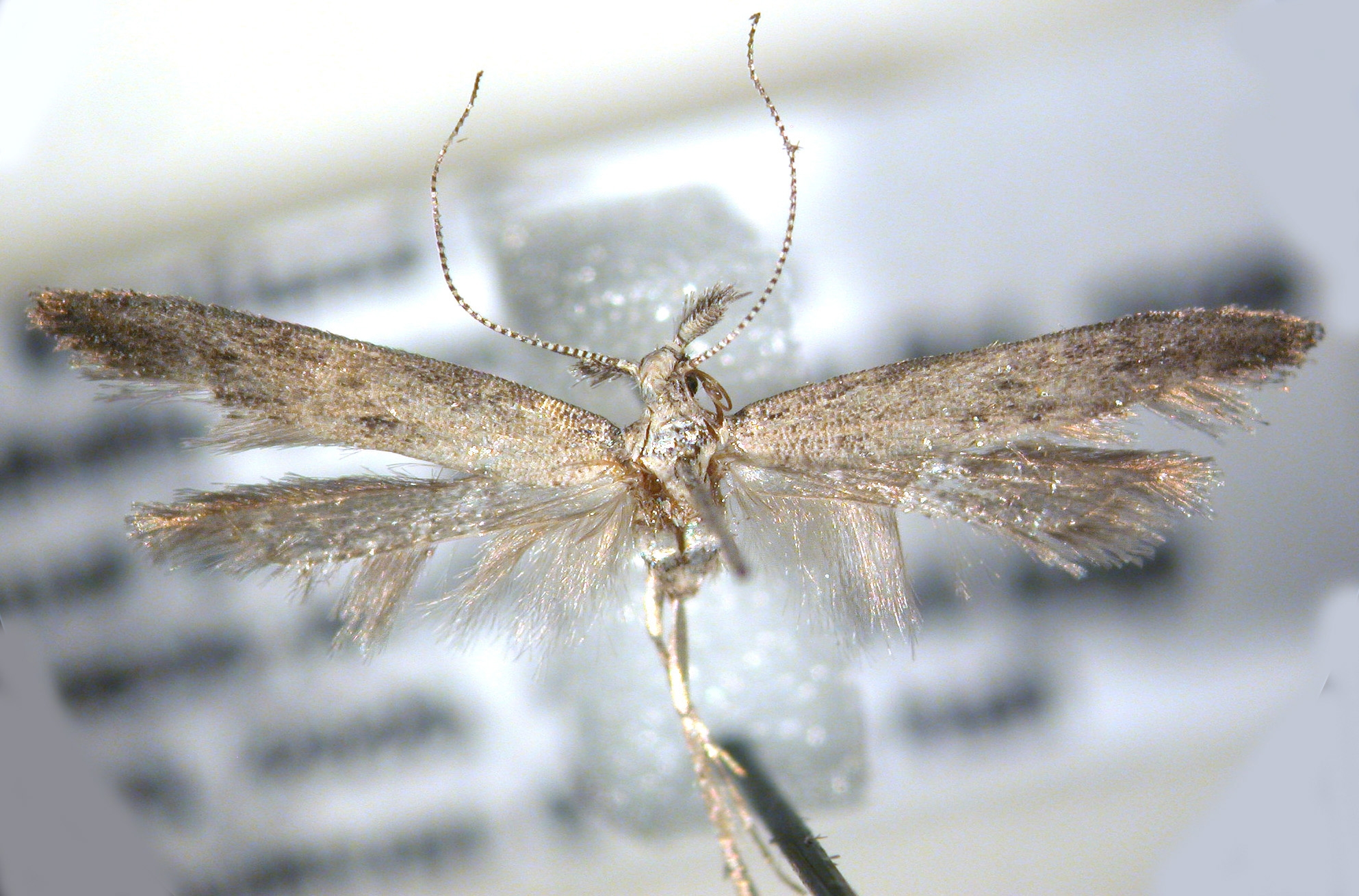
Isophrictis rudbeckiella
is a small moth with an overall grayish-brown color and a recurved labial palp that has long, rough, spreading hairs beneath the second segment. The following detailed description is based mostly on that of Bottimer (1926).
The antenna has alternating light-tan and dark-brown to blackish annulations, except for the basal joints that are lighter. The labial palp has a whitish to light-brown third segment, with the third segment being about as long as, or slightly shorter than, the second segment. The second segment is medium-brown and has a conspicuous tuft of long, spreading, brown hairs that ascend forward. The face is white, and the head and thorax are covered with white-tipped dark scales that produce a grainy appearance.
The forewing has patches and lines of white-tipped dark scales that produce a fine-grained, salt-and-peppery ground color. The ground is often overlain with two narrow longitudinal light tan to golden stripes with a black spot on the apical third of each. The first is centrally located and extends from the sub-basal region to around one-half the wing length, while the second is between it and the costa, and positioned slightly more apically. Additional shorter lines of similar color are sometimes evident, especially on the apical third where they tend to project towards the apex and are surrounded by a <-shaped group of grainy scales. Individuals vary in the degree of development of the light-colored lines, and in some specimens the primary and secondary lines may be faint or absent. The fringe is light-fuscous with two dark transverse lines, and the hindwing is dark silvery fuscous with light-fuscous cilia. The legs are silvery white and heavily overlaid with fuscous on the outside.
Isophrictis anteliella
is very similar to
A. rudbeckiella
, but has an oblique white line at around three-fourths that extends to the outer margin, and a rich fawn-brown color due to the absence of white-tipped, dark scales on the head, thorax and forewing as seen in
A. rudbeckiella
. A third species is present in the Sandhills that appears to be undescribed based on the genitalia, so we recommend dissecting all specimens from this region of the state.
Wingspan:
11.5-16 mm (Bottimer, 1926).
Adult Structural Features:
Bottimer (1926) has a description and illustration of the male genitalia.
Genitalia and other structural photos
Female genitalia; Stokes County; J.B. Sullivan.
Female genitalia; Richmond County; Jim Petranka.
Female genitalia; Richmond County; Jim Petranka.
Adult ID Requirements:
Identifiable only by close inspection of structural features or by DNA analysis.
Immatures and Development:
The larvae feed on the flower and seed heads of species of
Rudbeckia
, where they burrow through and consume tissues in both the receptacle and the developing seeds and fruits. Braun (1921) found the larvae to be very common in the flower heads of
Rudbeckia hirta
in the vicinity of Cincinnati. The whitish larvae burrowed into and fed on the receptacles of the flower heads. Just before pupating, they burrowed down into the stems for a distance of 1-8 cm, made an opening to the outside, then pupated in the stem. Bottimer (1926) observed larvae feeding throughout the flower heads of
Rudbeckia
in Texas, where they pupated either in a burrow in the flower head, or in the stem as observed by Braun (1921). Larvae in this region produced two broods. Adults from overwintering larvae produced adults in June, with larvae and pupae that were collected in mid-July producing a second emergence of adults from 26 July to 12 August. Additional larvae were found in September and November that overwintered in the seed heads and produced adults the following June.
Distribution in North Carolina
Distribution:
Populations that are currently assigned to
I. rudbeckiella
occur in both eastern and western North America and likely constitute a species complex. Only populations in the East are covered here, where they occur in Ontario and Quebec, and in the US from Maine, Massachusetts and New York westward to Ohio, Illinois, Wisconsin and Missouri. The range extends southwestward mostly through the Appalachian Region to eastern Tennessee and North Carolina, then onward to Alabama, Mississippi, Louisiana and eastern and central Texas. As of 2025, we have two records from the Sandhills that we have assigned to this species. The taxonomic status of these populations is not fully understood due to the presence of an apparently undescribed species that occurs in the same region.
County Map:
Clicking on a county returns the records for the species in that county.
Flight Dates:
High Mountains (HM) ≥ 4,000 ft.
Low Mountains (LM) < 4,000 ft.
Piedmont (Pd)
Coastal Plain (CP)
Click on graph to enlarge
Flight Comments:
Adults in eastern North America have been found from April through October. As of 2025, our two records are from August and September.
Habitats and Life History
Habitats:
As of 2025, both of our records come from bean dips in the Fall-line Sandhills.
Larval Host Plants:
As of 2025, the larvae are only known to feed on coneflowers (
Rudbeckia
spp.; Braun, 1921; Bottimer, 1926). The reported hosts include Black-eyed Susan
(R. hirta
) and Giant Coneflower (
R. maxima
). -
View
Observation Methods:
The adults are occasionally found at lights and the larvae can be found in developing heads of coneflowers.
Wikipedia
See also Habitat Account for
Loamy, Fire-maintained Herblands
Status in North Carolina
Natural Heritage Program Status:
Natural Heritage Program Ranks:
GNR SNR [S1S2]
State Protection:
Comments:
As of 2025, we have two records from the Sandhills that we have assigned to this species. The taxonomic status of the Sandhills populations is not fully understood due to the presence of an apparently undescribed species that occurs there.
Photo Gallery for
Isophrictis rudbeckiella
- None
Photos: 3
Recorded by: Jim Petranka, Mark Basinger and Becky Elkin on 2025-08-30
Richmond Co.
Comment:
Recorded by: Jim Petranka, Mark Basinger and Becky Elkin on 2025-08-30
Richmond Co.
Comment:
Recorded by: J.B. Sullivan on 2022-09-26
Scotland Co.
Comment:
 »
»