Moths of North Carolina
Scientific Name:
Common Name:
Family (Alpha):
« Home »
View PDFGelechiidae Members: Dichomeris Members: 14 NC Records

Dichomeris fistuca Hodges, 1986 - No Common Name


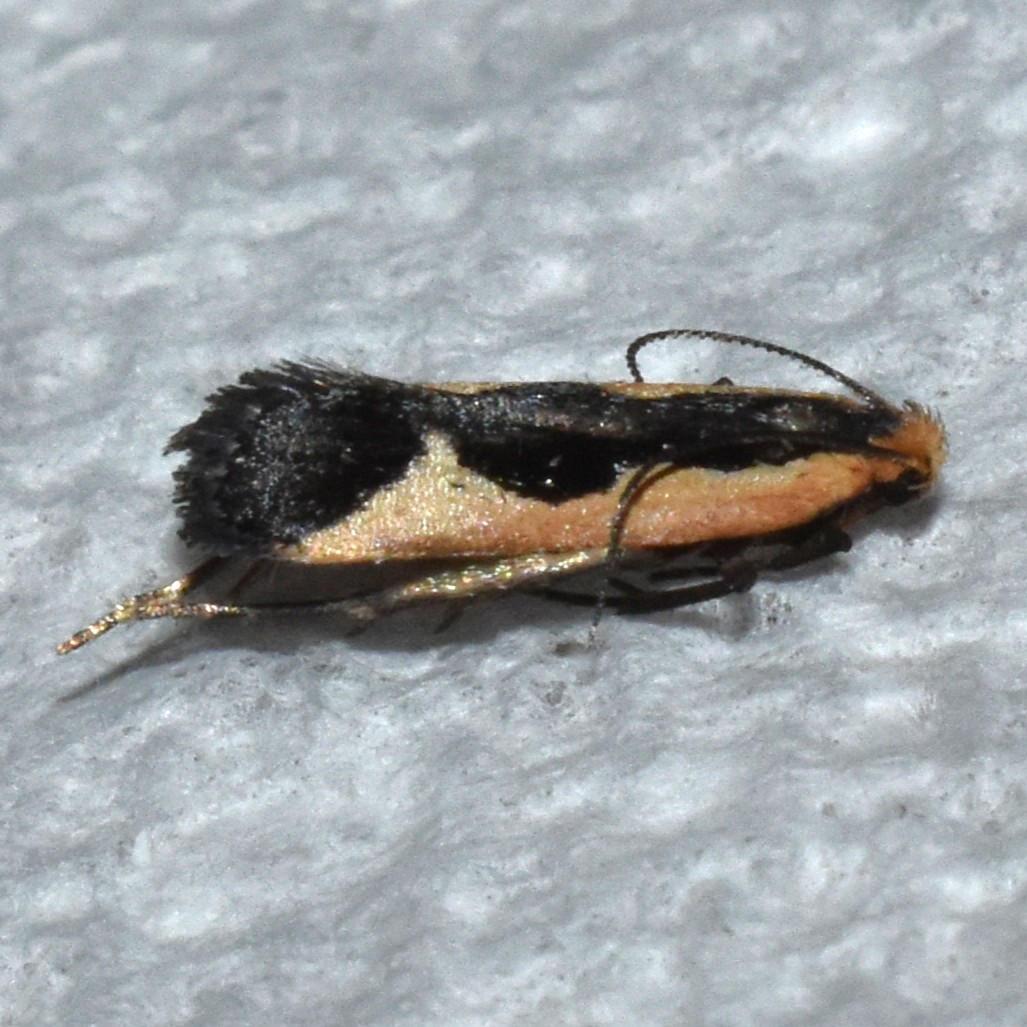
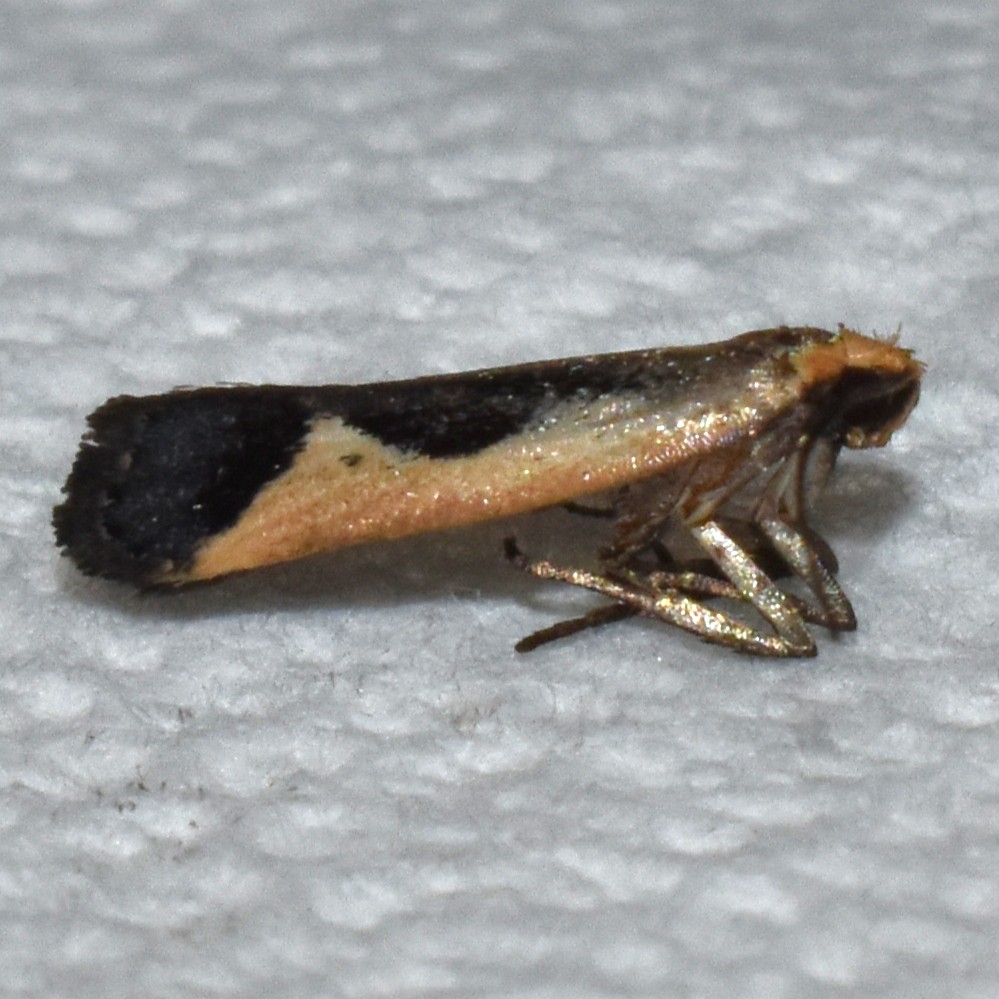
Dichomeris fistucaDichomeris fistucaDichomeris fistuca
Taxonomy
Superfamily:
Gelechioidea
Family:
Gelechiidae
Subfamily:
Dichomeridinae
P3 Number:
59a0530
MONA Number:
2295.10
Comments: Dichomeris is a large genus with several hundred species that occur throughout the world. Hodges (1986) recognized 74 species in North America north of Mexico, with 19 species groups. Most are leaftiers and they use a taxonomically diverse array of plant hosts, including members of 18 families of plants in North America. As of 2025, North Carolina has 35 documented species, and at least one undescribed species from the Sandhills.
Identification
Field Guide Descriptions: Online Resources: MPG, BugGuide, iNaturalist, Google, BAMONA, GBIF, BOLDTechnical Description, Adults: Hodges (1986).                                                                                 
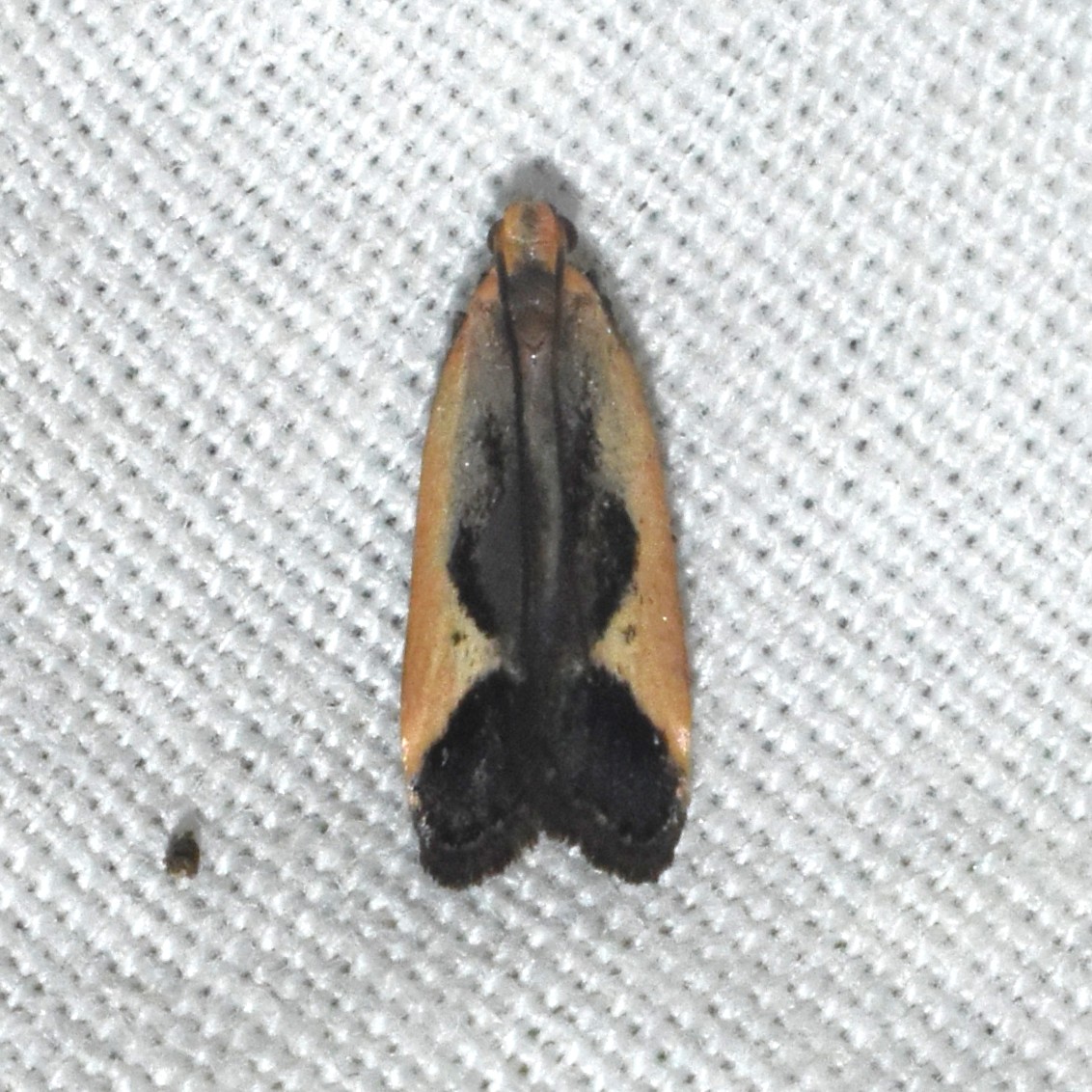
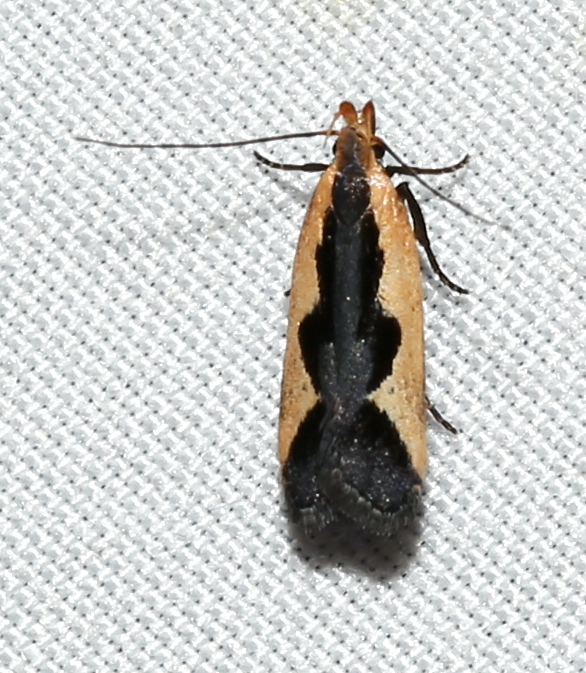
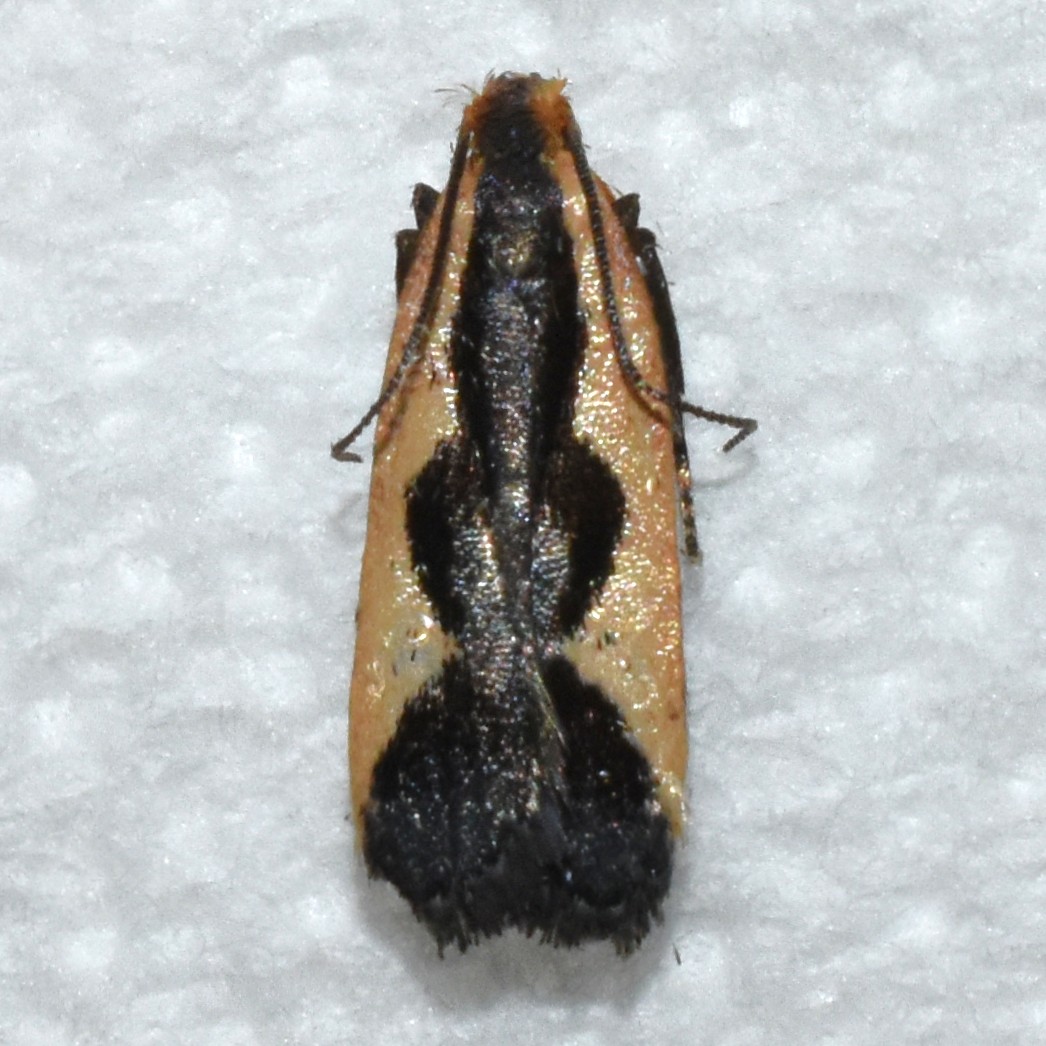
Adult Markings: Hodges (1986) reported that D. inserrata and D. fistuca have nearly identical external coloration and patterning and require the examination of genitalia for accurate identification. Both species have a two-toned forewing with a creamy-yellow to orangish-yellow region that fills most of the subcostal portion of the wing, along with two large, brownish-black to blackish marks on the remainder of the wing. The first extends from near the wing base along the inner margin and gradually widens near the middle of the wing, then curves inward and terminates on the inner margin at around three-fourths the wing length. The second is a semi-oval mark that fills most of the apical third of the wing. The two marks meet at around three-fourths the wing length and are partially separated by a broadly-angled tooth that tapers to a blunt tip just beyond the middle of the wing. Both species have a noticeable indention along the edge of the basal mark at around two-fifths the wing length that helps to separate these from D. flavocostella.

Although Hodges (1986) favored the use of genitalia for identification, he also noted that the shape of the posterior (inner) margin of the pale costal band in the forewing is useful for sorting these species out. For D. inserrata, the posterior margin is generally straight from the wing base to two-fifths the wing length where the black band bulges outward. It is also either straight or slightly convex as it cuts diagonally across the wing from about two-thirds the wing length to the subapical region of the costa. In contrast, the basal and terminal sections are usually bowed inward for D. fistuca. When combined with the middle section, these produce a pattern of three concave arches.

In North Carolina, Coastal Plain specimens of D. fistuca that have been identified based on genitalia tend to have a dull orangish-yellow color in the subcostal region. In contrast, D. inserrata from the mountains that have been identified based on genitalia tend to have a cream-colored to dull white subcostal region. Dichromeris fistuca from the Coastal Plain also commonly has one or more small teeth or indentions between the wing base and the major indentation at two-fifths, while D. inserrata from the Blue Ridge does not. In general, these two groups fit the patterns in maculation described above by Hodges (1986).

Most specimens from the Piedmont resemble D. inserrata from the mountains (see examples on iNaturalist), but have not been identified based on genitalia to confirm that they are this species. We elected to treat these as D. inserrata based on their maculation and geographic distribution, with the caveat that species from this region need confirmation based on the examination of genitalia. Hodges (1986) reported the range of D. fistuca to include Florida northward to coastal South Carolina, which is consistent with our tentative assignment of Piedmont populations to D. inserrata, i.e., that D. fistuca is rarely found outside of the Coastal Plain.
Forewing Length: 5.4-6.5 mm (Hodges, 1986).
Adult Structural Features: Hodges (1986) has illustrations and descriptions of the male and female genitalia. Also, see images from North Carolina specimens below.
Genitalia and other structural photos
Adult ID Requirements: Identifiable only by close inspection of structural features or by DNA analysis.
Immatures and Development: As of 2025, we are not aware of any documentation of the host plants or larval life history.
Larvae ID Requirements: Identifiable only through rearing to adulthood.
Distribution in North Carolina
Distribution: Dichomeris fistuca appears to be largely confined to Coastal Plain habitats from North Carolina southward to coastal South Carolina and southern Florida, and westward to the Florida Panhandle and an adjoining area in Alabama. A few scattered records have been reported from northern Alabama, western North Carolina and southern Minnesota. As of 2025, our records are mostly from the Sandhills and along the coast in Carteret County. J.B. Sullivan reported two specimens from a bog in Ashe County in the northern Blue Ridge that need further verification. iNaturalist records suggest that this species may be in decline, with recent records only known for North Carolina, a single site in southern Alabama and a small cluster in south-central Florida.
County Map: Clicking on a county returns the records for the species in that county.
Dichomeris fistucaAlamance Alexander Alleghany Anson Ashe Avery Beaufort Bertie Bladen Brunswick Buncombe Burke Cabarrus Caldwell Camden Carteret Caswell Catawba Chatham Cherokee Chowan Clay Cleveland Columbus Craven Cumberland Currituck Dare Davidson Davie Duplin Durham Edgecombe Forsyth Franklin Gaston Gates Graham Granville Greene Guilford Halifax Harnett Haywood Henderson Hertford Hoke Hyde Iredell Jackson Johnston Jones Lee Lenoir Lincoln Macon Madison Martin McDowell Mecklenburg Mitchell Montgomery Moore Nash New Hanover Northampton Onslow Orange Pamlico Pasquotank Pender Perquimans Person Pitt Polk Randolph Richmond Robeson Rockingham Rowan Rutherford Sampson Scotland Stanly Stokes Surry Swain Transylvania Tyrrell Union Vance Wake Warren Washington Watauga Wayne Wilkes Wilson Yadkin Yancey
Flight Dates:
High Mountains (HM) ≥ 4,000 ft.
Low Mountains (LM) < 4,000 ft.
Piedmont (Pd)
Coastal Plain (CP)

Click on graph to enlarge
Image showing flight dates by month for High Mountains greater than 4,000 feet, Low Mountains, Piedmont, and Coastal Plain: adults.
Flight Comments: The adults have been observed from March through September in different areas of the range. As of 2025, we have records from late-April through early-August.
Habitats and Life History
Habitats: Our records are mostly from xeric habitats that are often in close proximity to wetlands. The Blue Ridge records are a mountain bog.
Larval Host Plants: The larval host plants appear to be undocumented (Hodges, 1986). - View
Observation Methods: The adults are attracted to lights.
Wikipedia
Status in North Carolina
Natural Heritage Program Status:
Natural Heritage Program Ranks: GNR S2S3
State Protection:
Comments:

 Photo Gallery for Dichomeris fistuca - None

Photos: 5
Dichomeris fistuca
Recorded by: Jeff Niznik, David George, Larry Chen, Sarah Toner, Joye Zhou on 2025-06-20
Richmond Co.
Comment: Specimen was dissected.
Dichomeris fistuca
Recorded by: David George, Jeff Niznik on 2025-05-24
Richmond Co.
Comment: Specimen was dissected.
Dichomeris fistuca
Recorded by: David George, Jeff Niznik on 2025-05-24
Richmond Co.
Comment:
Dichomeris fistuca
Recorded by: Jeff Niznik, David George, Brian Bockhahn, Jim Petranka, Becky Elkin, John Petranka on 2025-05-09
Cumberland Co.
Comment: Specimen was dissected.
Dichomeris fistuca
Recorded by: Jeff Niznik, David George, Brian Bockhahn, Jim Petranka, Becky Elkin, John Petranka on 2025-05-09
Cumberland Co.
Comment: