Moths of North Carolina
Home Page
Recent Entries
Recent Account Updates
County Searches
General Search
Submit a Public Record
Larval Hosts
References
Maps
Draft Checklists
Family Photo Gallery
Family PDFs
NC Biodiversity Project
Comments
Significant Contributors
Scientific Name:
Common Name:
Family (Alpha):
Choose a Family
ACROLEPIIDAE-False Diamondback Moths
ADELIDAE-Fairy moths
ALUCITIDAE-Many-plumed Moths
AMPHISBATIDAE-
ARGYRESTHIIDAE-Shiny Head-standing Moths
AUTOSTICHIDAE-Autostichid Moths
BATRACHEDRIDAE-Batrachedrid Moths
BEDELLIIDAE-Bedelliid Moths
BLASTOBASIDAE-Blastobasid Moths
BOMBYCIDAE-Silkworm Moths
BUCCULATRICIDAE-Ribbed Cocoon-maker Moths
CARPOSINIDAE-Fruitworm Moths
CHOREUTIDAE-Metalmark Moths
COLEOPHORIDAE-Casebearer Moths and Relatives
COSMOPTERIGIDAE-Cosmopterigid Moths
COSSIDAE-Carpenter Moths, Goat Moths
CRAMBIDAE-Grass Moths, Snout Moths
DEPRESSARIIDAE-
DREPANIDAE-Hook-tips and Thyatirid Moths
DRYADAULIDAE-
ELACHISTIDAE-Grassminer Moths and Relatives
EPERMENIIDAE-Fringe-tufted Moths
EPIPYROPIDAE-Planthopper Parasite Moths
EREBIDAE-Erebid Moths
ERIOCRANIIDAE-Eriocraniid Moths
EUTELIIDAE-Euteliid Moths
GALACTICIDAE-Galacticid Moths
GELECHIIDAE-Gelechiid Moths; Twirler Moths
GEOMETRIDAE-Geometer Moths, Loopers
GLYPHIDOCERIDAE-Glyphidocerid Moths
GLYPHIPTERIGIDAE-Sedge Moths
GRACILLARIIDAE-Leafblotch miner moths
HELIOZELIDAE-Shield bearer moths
HEPIALIDAE-Ghost or Swift Moths
HYBLAEIDAE-
INCURVARIIDAE-Leafcutter Moths
LASIOCAMPIDAE-Tent Caterpillar Moths, Lappet Moths
LECITHOCERIDAE-Long-horned Moths
LIMACODIDAE-Slug Caterpillar Moths
LIMOCODIDAE-
LYONETIIDAE-Lyonetiid Moths
MEGALOPYGIDAE-Flannel Moths
MICROPTERIGIDAE-Mandibulate Moths
MIMALLONIDAE-
MOMPHIDAE-Mompha Moths
NEPTICULIDAE-Minute leaf miners
NOCTUIDAE-Owlet Moths
NOLIDAE-
NOTODONTIDAE-Prominents
OECOPHORIDAE-Oecophorid Moths
OPOSTEGIDAE-
PELEOPODIDAE-
PLUTELLIDAE-Diamondback Moths
PRODOXIDAE-Yucca Moths
PSYCHIDAE-Bagworm Moths
PTEROPHORIDAE-Plume Moths
PYRALIDAE-Pyralid Moths, Snout Moths
SATURNIIDAE-Giant Silkworm Moths
SCHRECKENSTEINIIDAE-Schreckensteiniid Moths
SCYTHRIDIDAE-
SESIIDAE-Clearwing Moths
SPHINGIDAE-Sphinx Moths
THYATIRIDAE-
THYRIDIDAE-Window-winged Moths
TINEIDAE-Clothes moths
TISCHERIIDAE-Tischerid Moths
TORTRICIDAE-Leafroller Moths
URANIIDAE-
URODIDAE-Urodid Moths
XYLORYCTIDAE-
YPONOMEUTIDAE-Ermine Moths
YPSOLOPHIDAE-Ypsolophid Moths
ZYGAENIDAE-
«
Home
»
View
PDF
Carposinidae Members:
Bondia crescentella
Carposina ottawana
Carposina unidentified species
Carposina
Members:
Carposina ottawana
Carposina unidentified species
9 NC Records
Carposina ottawana
Kearfott, 1907 - Peach Fruit Moth
Taxonomy
Superfamily:
Copromorphoidea
Family:
Carposinidae
P3 Number:
65a0006.1
MONA Number:
2314.00
MONA Synonym:
Carposina sasakii
Other Common Name:
American Peach Fruit Moth
Identification
Field Guide Descriptions:
Online Resources:
MPG
,
BugGuide
,
iNaturalist
,
Google
,
BAMONA
,
GBIF
,
BOLD
Technical Description, Adults:
Davis (1969)
Technical Description, Immature Stages:
Young and Robertson (2020)
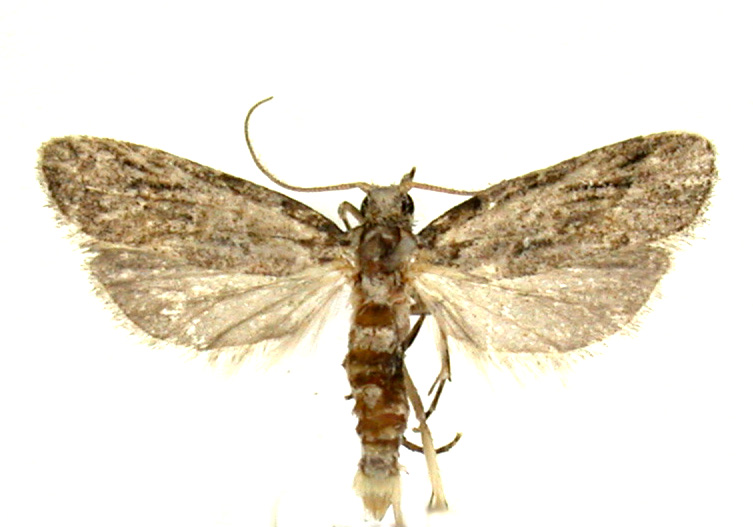
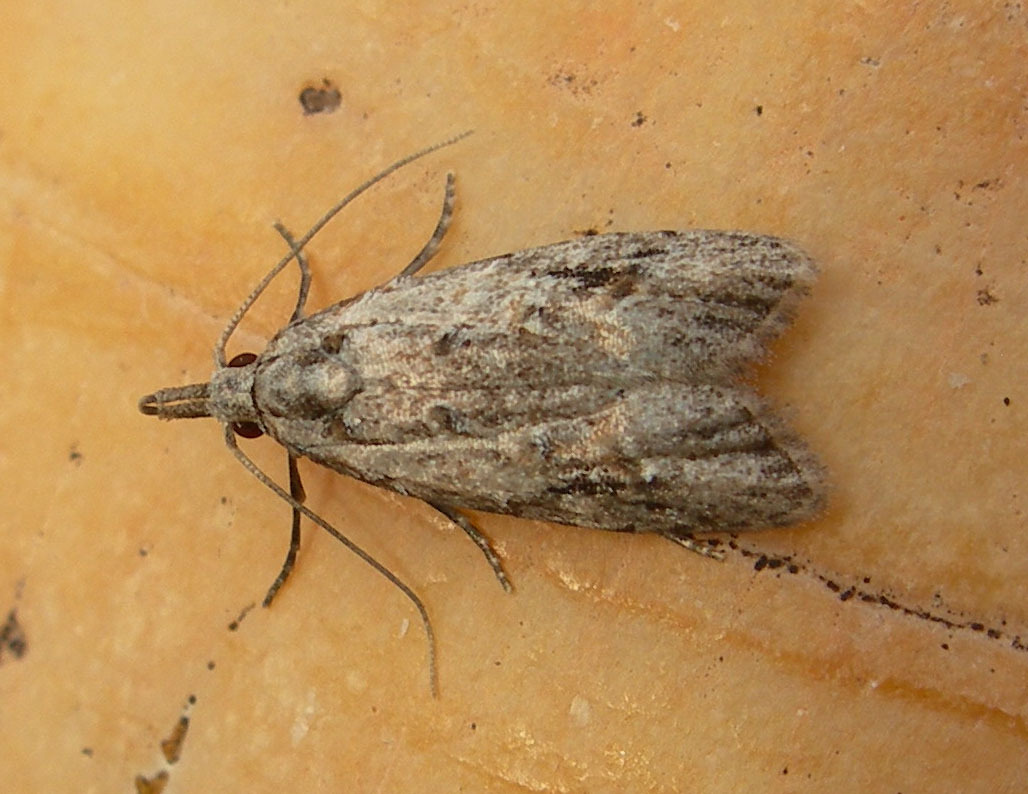
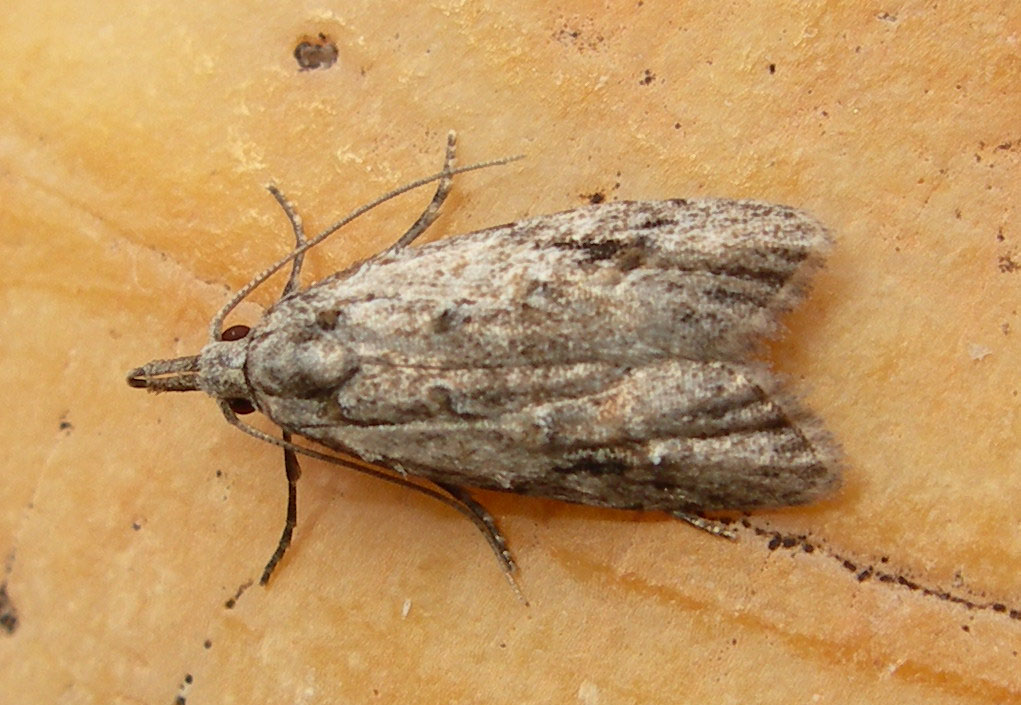
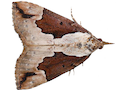
Adult Markings:
Carposina ottawana
and
C. fernaldana
are two closely related species that exhibit substantial variation in their external patterning and coloration. Davis (1969) noted that these species cannot be confidently identified using external maculation, and that specimens should be dissected for accurate identification. Although we do not have any records for
C. fernaldana
based on dissections as of 2025, it may very well occur in the state. The following is a general description that applies to both species.
The head is grayish white and the antenna uniformly light gray. The labial palp of the male has a scale tuft on the second segment that strongly projects forward, with the lateral and ventral surfaces fuscous, and the dorsal and inner surfaces lighter in color and pale gray. The second segment of the female is much shorter and usually has dorsolateral scales that are paler than the ventral ones. The apex of the third segment is whitish in both sexes.
The basal two-thirds of the forewing has a series of raised scale patches and ridges that gives it a bumpy appearance, but some or all may be missing in worn specimens. The ground color of the forewing is grayish, and in fresh specimens is usually heavily marked with fuscous dusting and larger dark marks. Specimens often have the costa marked with heavy blackish dusting that is narrow along the basal half, then wider at around two-thirds. In some specimens it may extend inward towards the apex of the cell where there is often one or two short, longitudinal streaks. A dark, transverse band is usually evident at the wing base of fresh specimens, but is often interrupted or missing in worn specimens. Finally, a line of dark fuscous dusting or dark spots is often evident on the outer margin, while the apical half of the costa often has the darker dusting organized as several dark spots. Many of the dark marks described above are subject to wear, so expect substantial deviations from the description above.
Wingspan:
12-13 mm (Davis, 1969).
Adult Structural Features:
Young and Robertson (2020) and Davis (1969) has descriptions and illustrations of the male and female genitalia. Also, see images of North Carolina specimens below.
Genitalia and other structural photos
Female genitalia; Carteret County (19-Sep-2017); J.B. Sullivan.
Aedeagus; Carteret County (19-Sep-2017); J.B. Sullivan.
Male genitalia; Jones County; J.B. Sullivan.
Male genitalia; Carteret County (19-Sep-2017); J.B. Sullivan.
Aedeagus; Jones County; J.B. Sullivan.
Adult ID Requirements:
Identifiable only by close inspection of structural features or by DNA analysis.
Immatures and Development:
The larvae are known to feed within the fruits of dogwoods and gooseberries (Davis, 1969), but the larval life history is poorly documented as of 2025. Young and Robertson (2020) have an illustration of a late-instar larva.
Larvae ID Requirements:
Identifiable from close inspection of specimens or by DNA analysis.
Distribution in North Carolina
Distribution:
The distribution of this species is rather poorly documented because of the need to examine genitalia for accurate identification. MPG shows the range in the US extending from Maine southward to South Carolina and northern Florida, and westward to central Texas, eastern Oklahoma, eastern Missouri and Illinois. Isolated records are also known for New Mexico, Colorado and Nebraska. In Canada, Pohl et al. (2018) have records for Alberta, Saskatchewan, Manitoba, Ontario, Quebec and Nova Scotia. As of 2025, all of our records are from the Coastal Plain. However, we have other records from the Piedmont and Blue Ridge for unidentified
Carposina
specimens that likely include this species (see '
Carposina
unidentified').
County Map:
Clicking on a county returns the records for the species in that county.
Flight Dates:
High Mountains (HM) ≥ 4,000 ft.
Low Mountains (LM) < 4,000 ft.
Piedmont (Pd)
Coastal Plain (CP)
Click on graph to enlarge
Flight Comments:
Specimens have been observed from March through November in different areas of the range, with most between June and September. As of 2025, our records extend from late-July through mid-October.
Habitats and Life History
Habitats:
Our records come from xeric, sandy habitats, including several from barrier island dunes and one from a site supporting xeric sandhill scrub.
Larval Host Plants:
Host use by this species has been a source of confusion due to taxonomic issues concerning whether
C. ottawana
is conspecific with one of two closely related southeast Asian species (
C. niponensis
;
C. sasakii
). The latter feeds on pome and stone fruits and is a major pest on apples, peaches and pears in Japan and surrounding regions.
Carposina ottawana
has been reported to feed on these also (Covell, 1984; Robinson et al., 2010), but Davis (1969) noted that this species is not a pest in fruit orchards in the US, and that the only known rearing records are for the fruits of Gray Dogwood (
Swida racemosa
and for a gooseberry [
Ribes
sp.]. We do not have any feeding records in North Carolina as of 2025. -
View
Observation Methods:
The adults are attracted to lights.
Wikipedia
Status in North Carolina
Natural Heritage Program Status:
[W-PK]
Natural Heritage Program Ranks:
[GNR] SNR [S1S2]
State Protection:
Comments:
We have only three site records as of 2025, but the scarcity of records may reflect in part the need to identify specimens based on genitalia.
Photo Gallery for
Carposina ottawana
- Peach Fruit Moth
Photos: 6
Recorded by: R. Newman on 2022-09-28
Carteret Co.
Comment:
Recorded by: R. Newman on 2022-09-27
Carteret Co.
Comment:
Recorded by: R. Newman on 2020-10-15
Carteret Co.
Comment:
Recorded by: R. Newman on 2020-10-14
Carteret Co.
Comment:
Recorded by: J.B. Sullivan on 2020-07-27
Jones Co.
Comment:
Recorded by: J.B. Sullivan on 2017-09-19
Carteret Co.
Comment:
 »
»