Moths of North Carolina
Home Page
Recent Entries
Recent Account Updates
County Searches
General Search
Submit a Public Record
Larval Hosts
References
Maps
Draft Checklists
Family Photo Gallery
Family PDFs
NC Biodiversity Project
Comments
Significant Contributors
Scientific Name:
Common Name:
Family (Alpha):
Choose a Family
ACROLEPIIDAE-False Diamondback Moths
ADELIDAE-Fairy moths
ALUCITIDAE-Many-plumed Moths
AMPHISBATIDAE-
ARGYRESTHIIDAE-Shiny Head-standing Moths
AUTOSTICHIDAE-Autostichid Moths
BATRACHEDRIDAE-Batrachedrid Moths
BEDELLIIDAE-Bedelliid Moths
BLASTOBASIDAE-Blastobasid Moths
BOMBYCIDAE-Silkworm Moths
BUCCULATRICIDAE-Ribbed Cocoon-maker Moths
CARPOSINIDAE-Fruitworm Moths
CHOREUTIDAE-Metalmark Moths
COLEOPHORIDAE-Casebearer Moths and Relatives
COSMOPTERIGIDAE-Cosmopterigid Moths
COSSIDAE-Carpenter Moths, Goat Moths
CRAMBIDAE-Grass Moths, Snout Moths
DEPRESSARIIDAE-
DREPANIDAE-Hook-tips and Thyatirid Moths
DRYADAULIDAE-
ELACHISTIDAE-Grassminer Moths and Relatives
EPERMENIIDAE-Fringe-tufted Moths
EPIPYROPIDAE-Planthopper Parasite Moths
EREBIDAE-Erebid Moths
ERIOCRANIIDAE-Eriocraniid Moths
EUTELIIDAE-Euteliid Moths
GALACTICIDAE-Galacticid Moths
GELECHIIDAE-Gelechiid Moths; Twirler Moths
GEOMETRIDAE-Geometer Moths, Loopers
GLYPHIDOCERIDAE-Glyphidocerid Moths
GLYPHIPTERIGIDAE-Sedge Moths
GRACILLARIIDAE-Leafblotch miner moths
HELIOZELIDAE-Shield bearer moths
HEPIALIDAE-Ghost or Swift Moths
HYBLAEIDAE-
INCURVARIIDAE-Leafcutter Moths
LASIOCAMPIDAE-Tent Caterpillar Moths, Lappet Moths
LECITHOCERIDAE-Long-horned Moths
LIMACODIDAE-Slug Caterpillar Moths
LIMOCODIDAE-
LYONETIIDAE-Lyonetiid Moths
MEGALOPYGIDAE-Flannel Moths
MICROPTERIGIDAE-Mandibulate Moths
MIMALLONIDAE-
MOMPHIDAE-Mompha Moths
NEPTICULIDAE-Minute leaf miners
NOCTUIDAE-Owlet Moths
NOLIDAE-
NOTODONTIDAE-Prominents
OECOPHORIDAE-Oecophorid Moths
OPOSTEGIDAE-
PELEOPODIDAE-
PLUTELLIDAE-Diamondback Moths
PRODOXIDAE-Yucca Moths
PSYCHIDAE-Bagworm Moths
PTEROPHORIDAE-Plume Moths
PYRALIDAE-Pyralid Moths, Snout Moths
SATURNIIDAE-Giant Silkworm Moths
SCHRECKENSTEINIIDAE-Schreckensteiniid Moths
SCYTHRIDIDAE-
SESIIDAE-Clearwing Moths
SPHINGIDAE-Sphinx Moths
THYATIRIDAE-
THYRIDIDAE-Window-winged Moths
TINEIDAE-Clothes moths
TISCHERIIDAE-Tischerid Moths
TORTRICIDAE-Leafroller Moths
URANIIDAE-
URODIDAE-Urodid Moths
XYLORYCTIDAE-
YPONOMEUTIDAE-Ermine Moths
YPSOLOPHIDAE-Ypsolophid Moths
ZYGAENIDAE-
«
Home
»
View
PDF
Glyphipterigidae Members:
Abrenthia cuprea
Diploschizia impigritella
Diploschizia lanista
Drymoana blanchardi
Glyphipterix nordini
Glyphipterix quadragintapunctata
Glyphipterix saurodonta
Glyphipterix unidentified species
Diploschizia
Members:
Diploschizia impigritella
Diploschizia lanista
23 NC Records
Diploschizia lanista
(Meyrick, 1918) - No Common Name
Taxonomy
Superfamily:
Yponomeutoidea
Family:
Glyphipterigidae
Subfamily:
Glyphipteriginae
P3 Number:
36a0218
MONA Number:
2345.00
Identification
Field Guide Descriptions:
Online Resources:
MPG
,
BugGuide
,
iNaturalist
,
Google
,
BAMONA
,
GBIF
,
BOLD
Technical Description, Adults:
Heppner (1985)
Adult Markings:
Diploschizia lanista
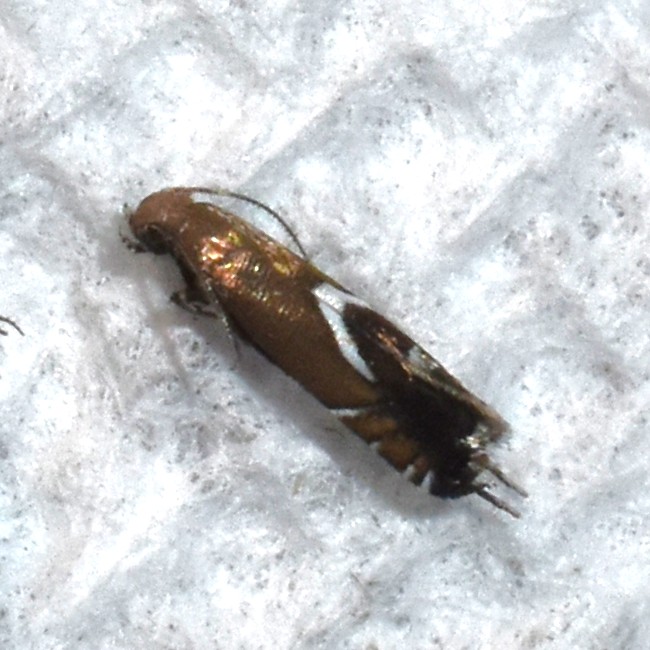
is a very small grayish-brown to reddish-brown moth with a large, narrow, white crescent on the dorsal margin of the forewing, and four white streaks on the apical third of the costa. The following detailed description is based on that of Heppner (1981). The labial palp is white dorsally, with both the second and third segments having two alternating bands of black and white. The head is grayish-fuscous and has a small white posterolateral eye margin. The antenna is fuscous dorsally, while the thorax and patagia are grayish-fuscous. The forewing is grayish-fuscous over the basal two-thirds, and dark fuscous on the apical third. The dorsal margin has a large white crescent at the midwing, with the point directed towards the apex. The costal margin has a white oblique streak at around two-thirds the wing length that projects towards the tornus. It is followed by three shorter white streaks near the apex. All of the costal streaks are thinly margined with dark-brown scales. In addition to the streaks, the tornus has a white spot, while the apex has a black spot. The fringe is fuscous, except for being white near the terminal edge, and having a white mark at its falcate indentation. The hindwing and fringe are both fuscous, while the legs are fuscous with white at the joints.
Diploschizia lanista
can be confused with
D. impigritella
, but the latter has five white streaks on the costa instead of four as seen on
D. lanista
(Heppner, 1985).
Forewing Length:
2.7-4.0 mm (Heppner, 1981).
Adult Structural Features:
Heppner (1981) has illustrations and descriptions of the male genitalia.
Genitalia and other structural photos
Male genitalia; Richmond County; Jim Petranka.
Adult ID Requirements:
Identifiable from good quality photos of unworn specimens.
Immatures and Development:
As of 2025, we are unaware of any documentation of the larval life history.
Larvae ID Requirements:
Identifiable only through rearing to adulthood.
Distribution in North Carolina
Distribution:
Diploschizia lanista
is restricted to the southeastern Coastal Plain from southeastern North Carolina southward to southern Florida. Specimens have also been collected in Texas, and MPG has one specimen from Oklahoma. As of 2025, all of our records are from the Sandhills.
County Map:
Clicking on a county returns the records for the species in that county.
Flight Dates:
High Mountains (HM) ≥ 4,000 ft.
Low Mountains (LM) < 4,000 ft.
Piedmont (Pd)
Coastal Plain (CP)
Click on graph to enlarge
Flight Comments:
The adults are active year-round in Florida, and from March through October at sites farther north. As of 2025, our records extend from early-April through mid-October. Local populations in North Carolina appear to be multivoltine.
Habitats and Life History
Habitats:
All of our current records for this species come from the Fall-line Sandhills and sites with a high clay content, including bean dips, seeps, and mixed oak woodlands.
Larval Host Plants:
The hosts are apparently undocumented. Related species feed on nut-sedges (
Cyperus
species). -
View
Wikipedia
See also Habitat Account for
Loamy, Fire-maintained Herblands
Status in North Carolina
Natural Heritage Program Status:
Natural Heritage Program Ranks:
GNR SNR [S1S2]
State Protection:
Comments:
This species is relatively rare throughout its range and reaches its northern range limit in the Sandhills, where it appears to be restricted to sites with high clay content such as bean dips.
Photo Gallery for
Diploschizia lanista
- None
Photos: 4
Recorded by: David George, Jeff Niznik, Rob Van Epps, Kevin Metcalf on 2025-07-20
Richmond Co.
Comment:
Recorded by: Jeff Niznik, David George, Larry Chen, Sarah Toner, Joye Zhou on 2025-06-20
Richmond Co.
Comment:
Recorded by: David George, Jeff Niznik on 2025-05-24
Richmond Co.
Comment:
Recorded by: J.B. Sullivan on 2022-09-26
Scotland Co.
Comment:
 »
»