Moths of North Carolina
Home Page
Recent Entries
Recent Account Updates
County Searches
General Search
Submit a Public Record
Larval Hosts
References
Maps
Draft Checklists
Family Photo Gallery
Family PDFs
NC Biodiversity Project
Comments
Significant Contributors
Scientific Name:
Common Name:
Family (Alpha):
Choose a Family
ACROLEPIIDAE-False Diamondback Moths
ADELIDAE-Fairy moths
ALUCITIDAE-Many-plumed Moths
AMPHISBATIDAE-
ARGYRESTHIIDAE-Shiny Head-standing Moths
AUTOSTICHIDAE-Autostichid Moths
BATRACHEDRIDAE-Batrachedrid Moths
BEDELLIIDAE-Bedelliid Moths
BLASTOBASIDAE-Blastobasid Moths
BOMBYCIDAE-Silkworm Moths
BUCCULATRICIDAE-Ribbed Cocoon-maker Moths
CARPOSINIDAE-Fruitworm Moths
CHOREUTIDAE-Metalmark Moths
COLEOPHORIDAE-Casebearer Moths and Relatives
COSMOPTERIGIDAE-Cosmopterigid Moths
COSSIDAE-Carpenter Moths, Goat Moths
CRAMBIDAE-Grass Moths, Snout Moths
DEPRESSARIIDAE-
DREPANIDAE-Hook-tips and Thyatirid Moths
DRYADAULIDAE-
ELACHISTIDAE-Grassminer Moths and Relatives
EPERMENIIDAE-Fringe-tufted Moths
EPIPYROPIDAE-Planthopper Parasite Moths
EREBIDAE-Erebid Moths
ERIOCRANIIDAE-Eriocraniid Moths
EUTELIIDAE-Euteliid Moths
GALACTICIDAE-Galacticid Moths
GELECHIIDAE-Gelechiid Moths; Twirler Moths
GEOMETRIDAE-Geometer Moths, Loopers
GLYPHIDOCERIDAE-Glyphidocerid Moths
GLYPHIPTERIGIDAE-Sedge Moths
GRACILLARIIDAE-Leafblotch miner moths
HELIOZELIDAE-Shield bearer moths
HEPIALIDAE-Ghost or Swift Moths
HYBLAEIDAE-
INCURVARIIDAE-Leafcutter Moths
LASIOCAMPIDAE-Tent Caterpillar Moths, Lappet Moths
LECITHOCERIDAE-Long-horned Moths
LIMACODIDAE-Slug Caterpillar Moths
LIMOCODIDAE-
LYONETIIDAE-Lyonetiid Moths
MEGALOPYGIDAE-Flannel Moths
MICROPTERIGIDAE-Mandibulate Moths
MIMALLONIDAE-
MOMPHIDAE-Mompha Moths
NEPTICULIDAE-Minute leaf miners
NOCTUIDAE-Owlet Moths
NOLIDAE-
NOTODONTIDAE-Prominents
OECOPHORIDAE-Oecophorid Moths
OPOSTEGIDAE-
PELEOPODIDAE-
PLUTELLIDAE-Diamondback Moths
PRODOXIDAE-Yucca Moths
PSYCHIDAE-Bagworm Moths
PTEROPHORIDAE-Plume Moths
PYRALIDAE-Pyralid Moths, Snout Moths
SATURNIIDAE-Giant Silkworm Moths
SCHRECKENSTEINIIDAE-Schreckensteiniid Moths
SCYTHRIDIDAE-
SESIIDAE-Clearwing Moths
SPHINGIDAE-Sphinx Moths
THYATIRIDAE-
THYRIDIDAE-Window-winged Moths
TINEIDAE-Clothes moths
TISCHERIIDAE-Tischerid Moths
TORTRICIDAE-Leafroller Moths
URANIIDAE-
URODIDAE-Urodid Moths
XYLORYCTIDAE-
YPONOMEUTIDAE-Ermine Moths
YPSOLOPHIDAE-Ypsolophid Moths
ZYGAENIDAE-
«
Home
»
View
PDF
Tineidae Members:
Acrolophus arcanella
Acrolophus cressoni
Acrolophus forbesi
Acrolophus mora
Acrolophus mortipennella
Acrolophus mycetophagus
Acrolophus panamae
Acrolophus piger
Acrolophus plumifrontella
Acrolophus popeanella
Acrolophus propinqua
Acrolophus simulatus
Acrolophus spilotus
Acrolophus texanella
Acrolophus unidentified species
Amydria brevipennella
Amydria clemensella
Amydria effrenatella
Amydria new species eskeri
Amydria unidentified species
Augolychna septemstrigella
Diachorisia unidentified species
Diachorisia velatella
Diataga leptosceles
Eccritothrix guenterella
Elatobia carbonella
Homosetia argentinotella
Homosetia bifasciella
Homosetia costisignella
Homosetia fasciella
Homosetia marginimaculella
Homosetia new species 1
Homosetia tricingulatella
Homosetia unidentified species
Homostinea curviliniella
Hybroma servulella
Isocorypha mediostriatella
Kearfottia albifasciella
Leucomele miriamella
Mea bipunctella
Mea skinnerella
Monopis crocicapitella
Monopis dorsistrigella
Monopis longella
Monopis marginistrigella
Monopis unidentified species
Montescardia fuscofasciella
Nemapogon acapnopennella
Nemapogon angulifasciella
Nemapogon auropulvella
Nemapogon clematella of authors
Nemapogon granella
Nemapogon interstitiella
Nemapogon multistriatella
Nemapogon rileyi
Nemapogon unidentified species
Nemapogon variatella
Niditinea fuscella
Niditinea orleansella
Niditinea sabroskyi
Niditinea unidentified species
Oenoe hybromella
Oenoe unidentified species
Pelecystola nearctica
Phereoeca uterella
Philonome clemensella
Scardia amurensis
Scardia anatomella
Scardiella approximatella
Setomorpha rutella
Stenoptinea auriferella
Stenoptinea unidentified species
Tinea apicimaculella
Tinea carnariella
Tinea croceoverticella
Tinea mandarinella
Tinea pellionella complex
Tinea unidentified species
Tinea unomaculella
Tineidae n. sp.
Tineidae new species No. 2
Tineidae unidentified species
Tineola bisselliella
Trichophaga tapetzella
Xylesthia n. sp.
Xylesthia pruniramiella
Xylesthia unidentified species
Xystrologa n. sp. 1
Xystrologa n. sp. 5
Xystrologa unidentified species
Diachorisia
Members:
Diachorisia unidentified species
Diachorisia velatella
67 NC Records
Diachorisia velatella
Clemens, 1860 - Brown-spotted Diachorisia
Taxonomy
Superfamily:
Tineoidea
Family:
Tineidae
Subfamily:
Meessiinae
Tribe:
[Meessiini]
P3 Number:
300213
MONA Number:
279.00
Comments:
Diachorisia
is a monotypic genus that is restricted to eastern North America.
Identification
Field Guide Descriptions:
Online Resources:
MPG
,
BugGuide
,
iNaturalist
,
Google
,
BAMONA
,
GBIF
,
BOLD
Technical Description, Adults:
Forbes (1923)
Adult Markings:
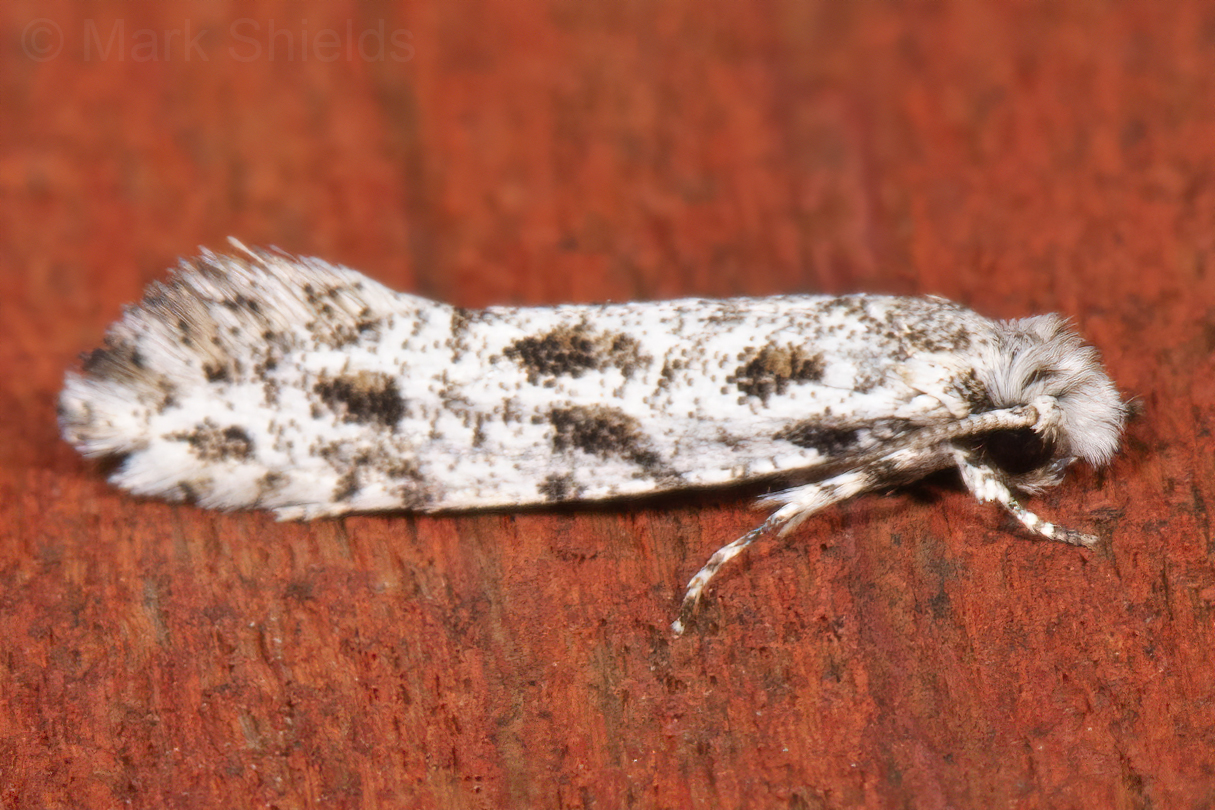
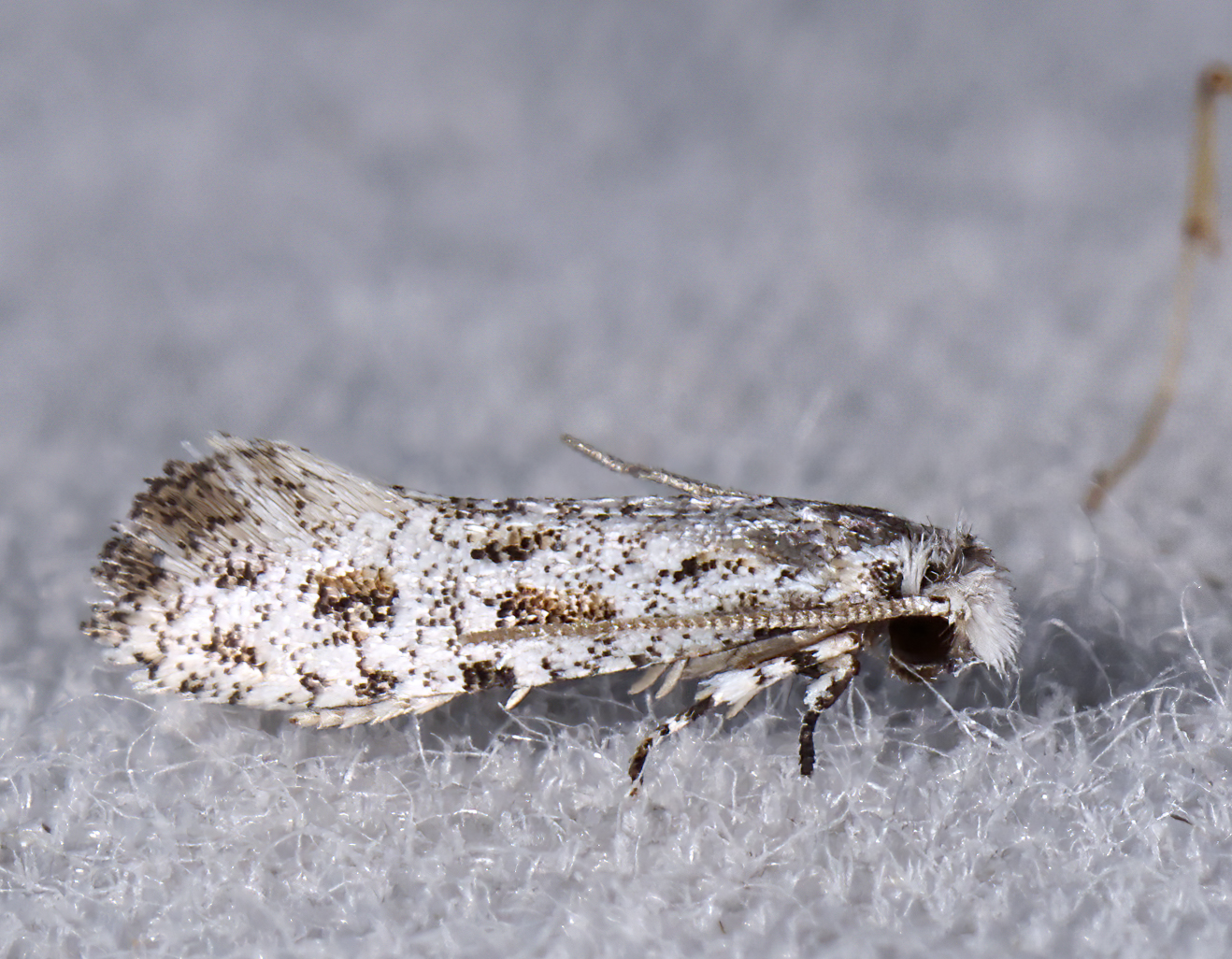
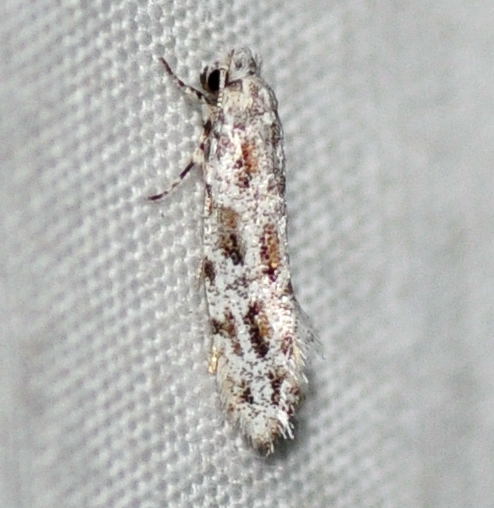
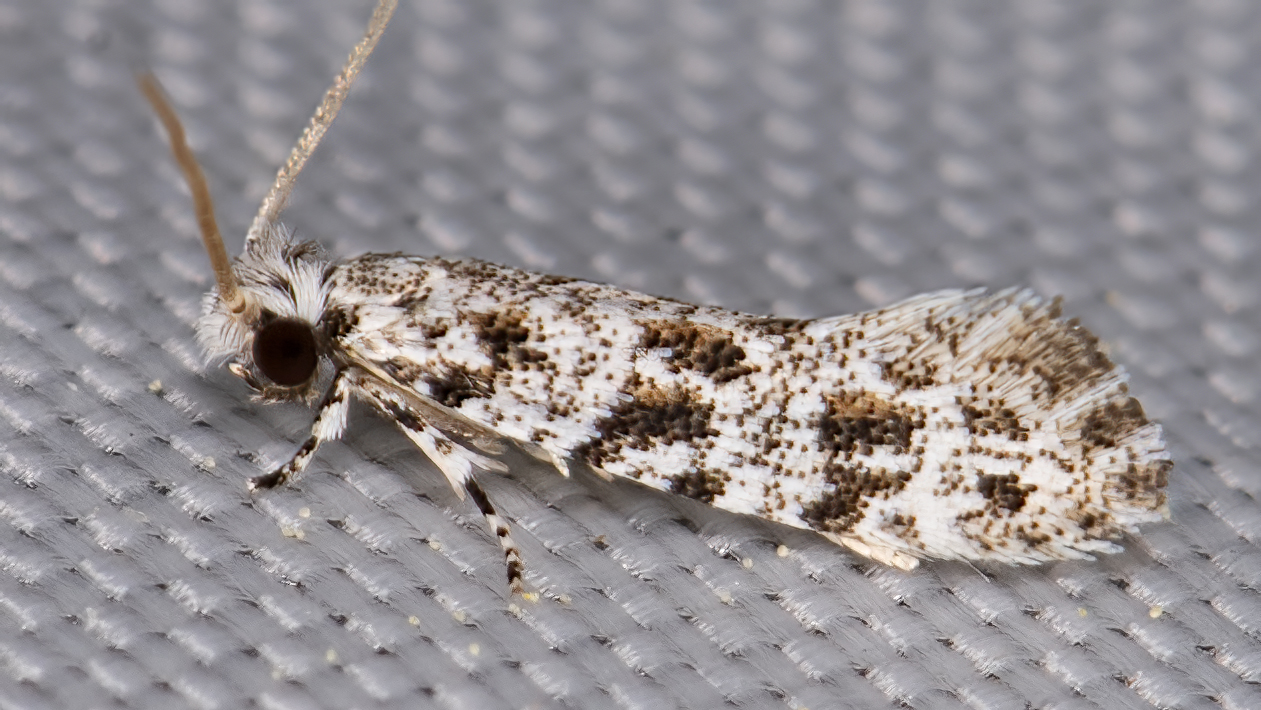
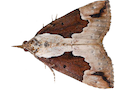
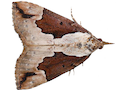
The following description is based in part on Forbes' description (1923). The head has a mix of brown and gray scales and the palps are dark outwardly. The antenna is whitish with varying levels of faint fuscous dusting. The ground color of the forewing is white and dusted with fuscous. There are four or five small dark spots along the costa. These begin just before the base and are spaced roughly equidistantly to about two-thirds the wing length. Two larger, elongated blotches occur near the mid-length of the wing. These are spaced between the costa and inner margin, and the costal blotch is slightly more basal. Two additional large blotches are usually evident, one posteriorly and one anterior to the two paired blotches at the mid-length of the wing. Both are centered between the costa and inner margin. The apical region typically has one or more additional small spots or blotches, and one or two other small blotches are sometimes present along the inner margin. The cilia are white with scattered fuscous dusting, and often have two or more rather poorly organized blotches. The legs are white with varying levels of darker spotting and banding.
Wingspan:
9 mm (Forbes, 1923).
Adult Structural Features:
On the antenna, the outer whorls of scales on each segment are nearly complete, but no longer than the inner whorls. The ventral surface has strong pubescence. It is as long as a segment in the male, but shorter in the female. The hindwing shows the cubitus and Cu2 running straight across to the inner margin, with a quarter of the width of the wing below it. Cu2 is half as long as the width of the wing. In the rest of the genus, Cu is closely parallel to the inner margin, and the free part of Cu is very short (Forbes, 1923).
Genitalia and other structural photos
Male genitalia; Orange County; Jim Petranka.
Adult ID Requirements:
Identifiable from good quality photos of unworn specimens.
Immatures and Development:
Despite having numerous adult records, the larval ecology and life history are largely unknown.
Larvae ID Requirements:
Identifiable only through rearing to adulthood.
Distribution in North Carolina
Distribution:
Diachorisia velatella
is found in eastern North America, including Ontario and much of the eastern US. Populations have been found from Maine and Massachusetts southwestward to the Gulf Coastal region. The range extends as far west as central Texas and central Oklahoma. We have scattered records from throughout the state.
County Map:
Clicking on a county returns the records for the species in that county.
Flight Dates:
High Mountains (HM) ≥ 4,000 ft.
Low Mountains (LM) < 4,000 ft.
Piedmont (Pd)
Coastal Plain (CP)
Click on graph to enlarge
 »
»