Moths of North Carolina
Scientific Name:
Common Name:
Family (Alpha):
« Home »
View PDFGracillariidae Members: Phyllonorycter Members: 4 NC Records

Phyllonorycter maestingella (Müller, 1764) - Beech Midget


Phyllonorycter maestingella
view caption
Phyllonorycter maestingella
view caption
Phyllonorycter maestingellaPhyllonorycter maestingella
view caption
Taxonomy
Family:
Gracillariidae
P3 Number:
330302.00
MONA Number:
786.00
Species Status: Limited DNA barcoding indicate that specimens in North America match those from European populations and that Phyllonorycter maestingella in the US are likely introduced. Populations in the southern Appalachians have not been barcoded and could potentially be native. At present, we are treating these as introduced.
Identification
Field Guide Descriptions: Online Resources: MPG, BugGuide, iNaturalist, Google, BAMONA, GBIF, BOLD, iNat SearchTechnical Description, Adults: Braun (1939)Technical Description, Immature Stages: Eiseman (2022)                                                                                 
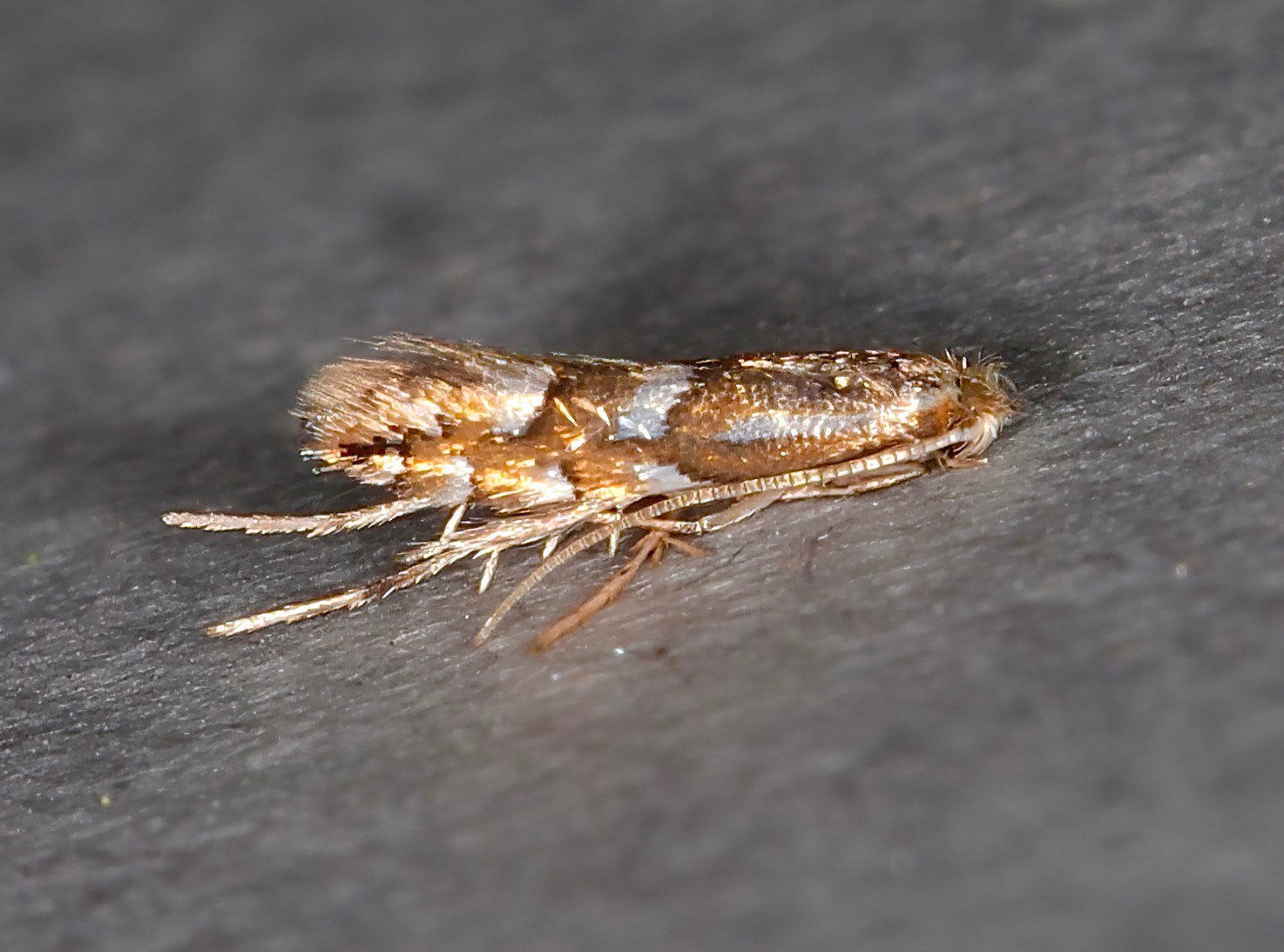
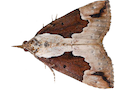
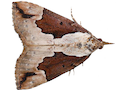
Adult Markings: Phyllonorycter maestingella is a small micromoth with a light golden-brown ground color on the forewing that is boldly marked with a series of white streaks with black margins anteriorly. The following detailed description is based on that of Braun (1939). The face and labial palps are silvery white, with the latter shaded with fuscous outwardly. The head tuft has a mixture of white and brown scales, and the antenna is mostly white with brownish coloration towards the tip. The thorax is golden-brown, with lateral and median white lines.

The forewing has a median longitudinal white streak from the base to one-third the wing length, and a short white streak along the inner margin near the base. A fine, dark-brown line extends along the costa from the base to the first white costal streak just before the middle. From there, it angles inward to form the inner dark margin of the streak. Opposite the first costal streak, there is a matching white, and rather broadly triangular, dorsal streak, with the apices of this pair separated by a small gap. Beyond the first pair of streaks there are three costal streaks, with the last two often united. There are also two dorsal streaks. The first is about the size and shape of the first dorsal streak, with its apex a little beyond that of the corresponding costal streak. The second is much smaller and between the last two costal streaks. All of the streaks are dark-margined of the anterior side, and there is an elongated patch of black scales near the apex. The fringe is whitish, with the marginal row of scales around the apex blue-tipped. The hindwing and fringe are grayish white and faintly tinged with ocherous. The legs are mostly silvery white, with the anterior pair fuscous inwardly, and the middle and posterior pair very faintly tinged with fuscous at the tips of the segments.
Wingspan: 5.5-6.0 mm (Braun, 1939).
Adult ID Requirements: Identifiable from good quality photos of unworn specimens.
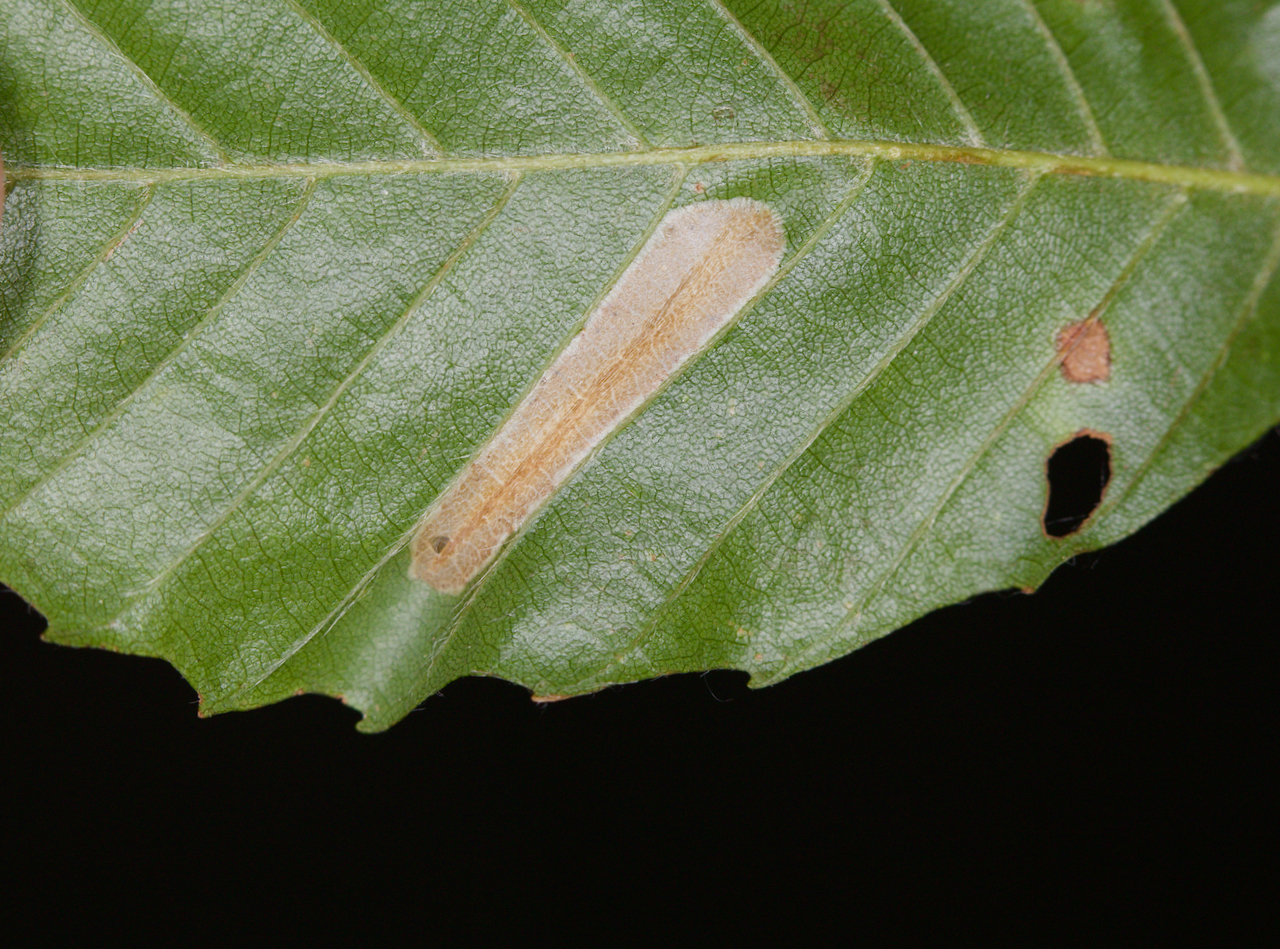
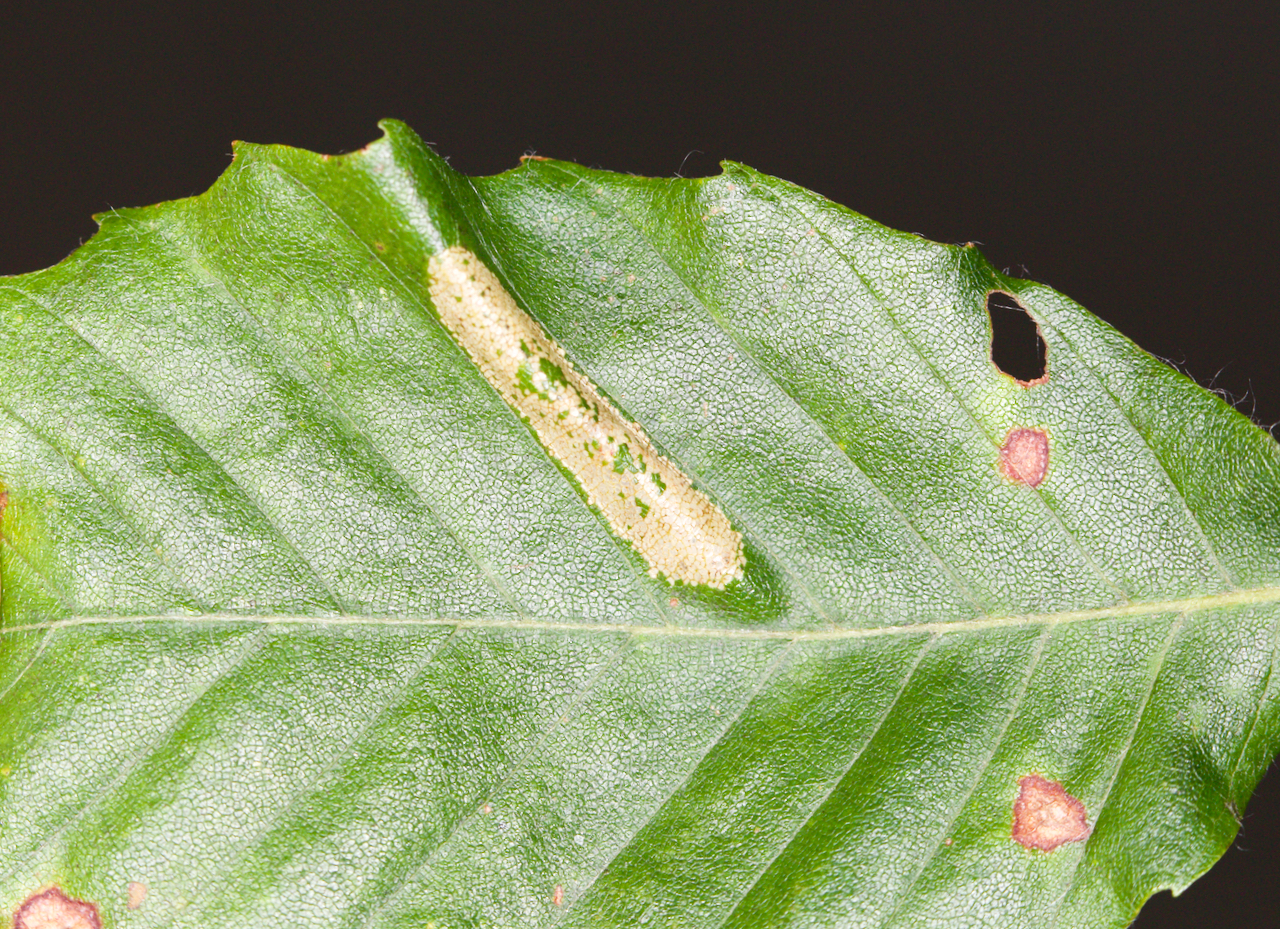
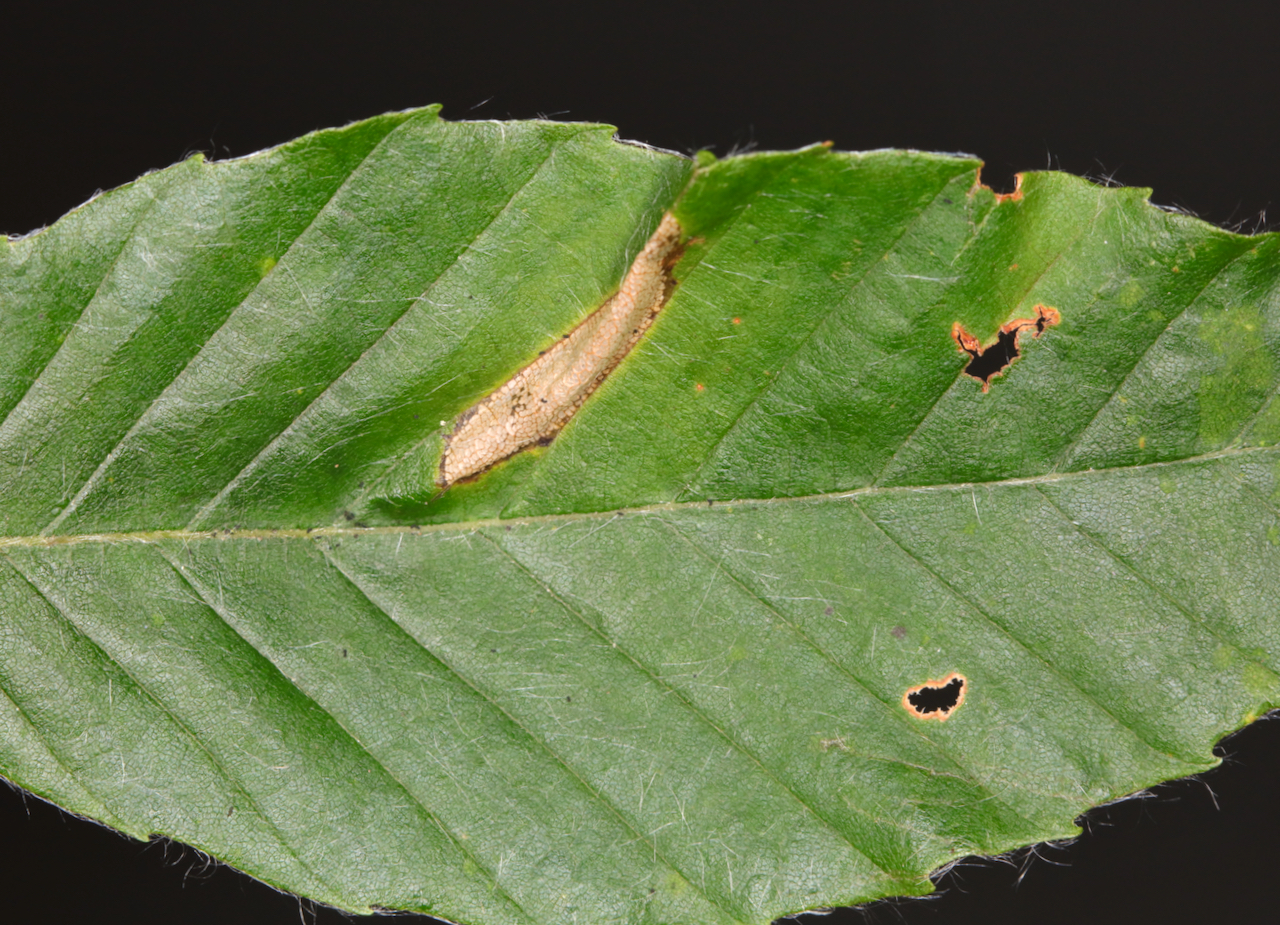
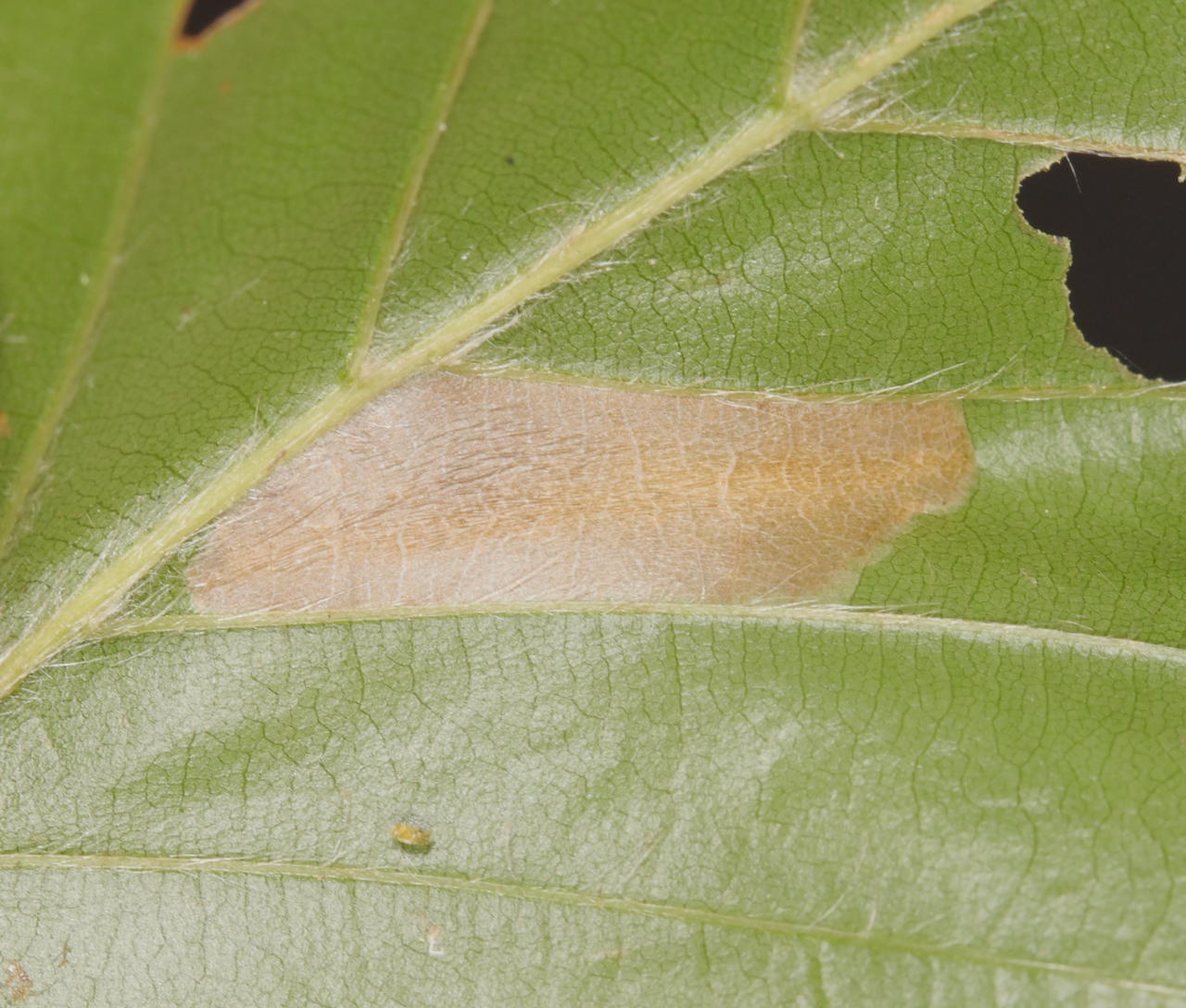
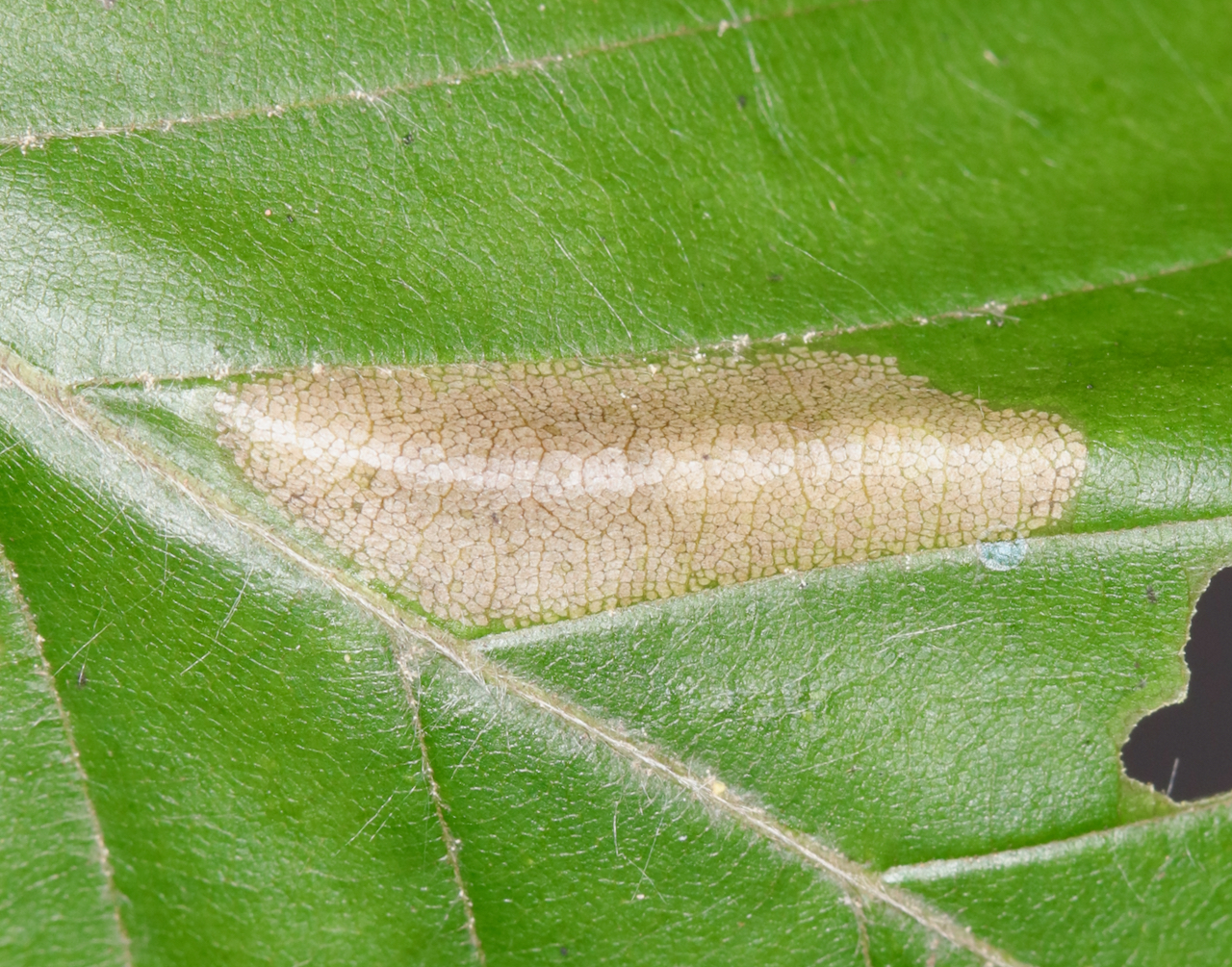
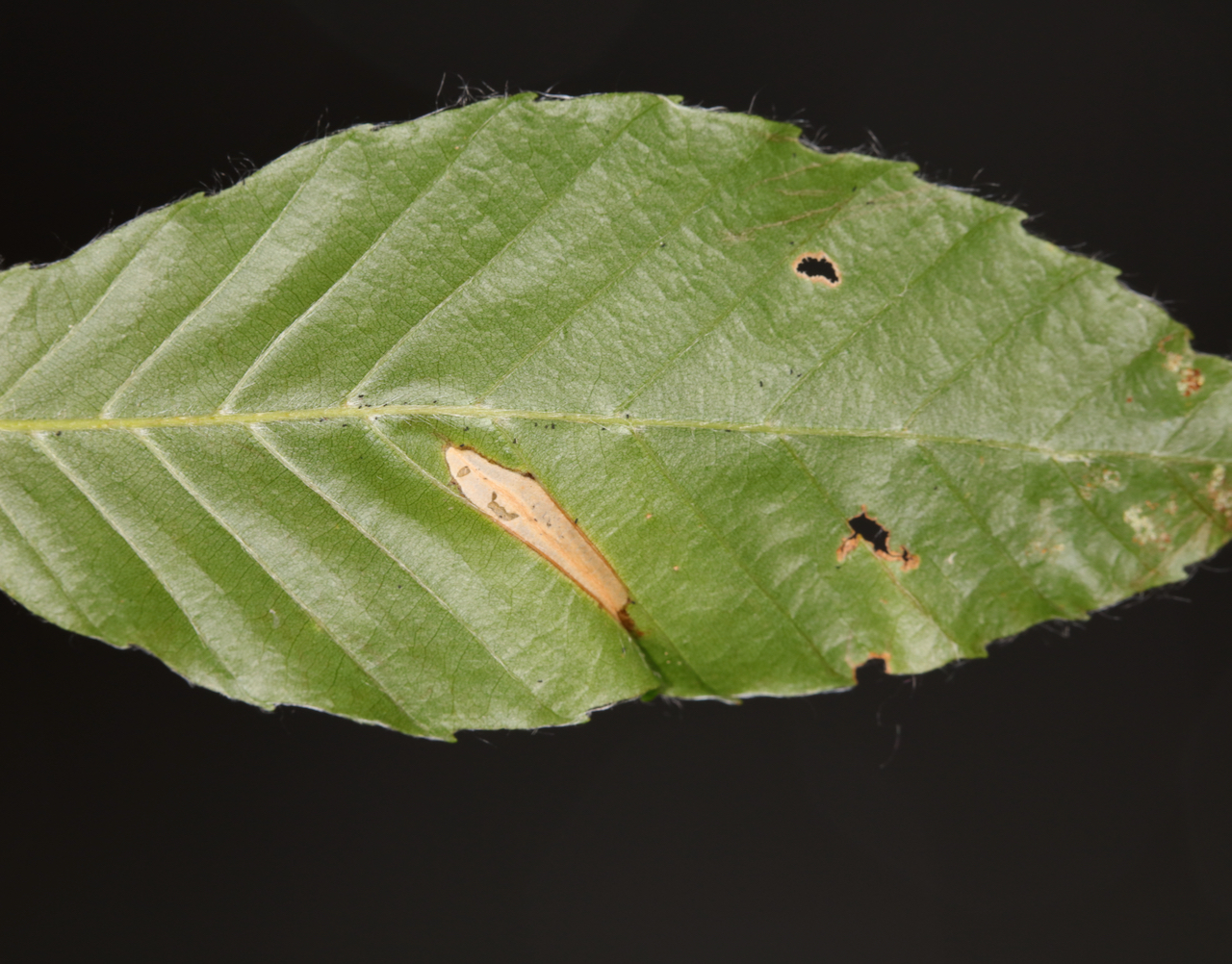
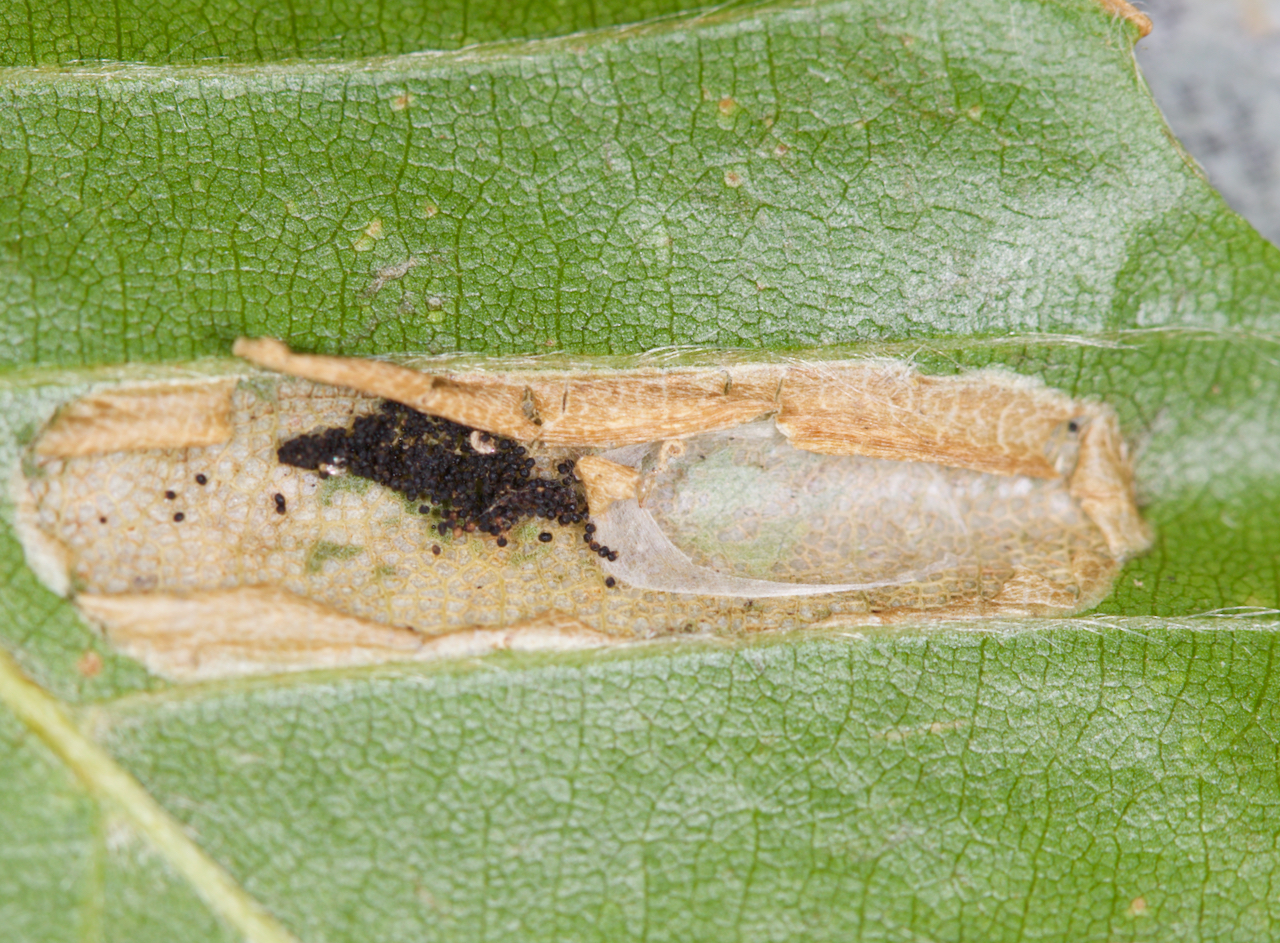
Immatures and Development: The larvae are leaf miners and use American Beech as the primary host. The following life history summary is mostly based on that of Braun (1939) and Eiseman (2022). Females lay their eggs singly on the lower leaf surface near a lateral vein. The mine begins as a 5–7 mm elongate blotch along the vein, then expands into an elongated, tentiform mine between two lateral veins. Exceptionally large mines can extend from the midrib all the way to the leaf margin. The lower epidermis has a number of fine, closely-set wrinkles that can superficially resemble a single, large, longitudinal crease. The frass can be either heaped at one end of the mine -- with the larva pupating at the other end -- or scattered randomly, with the pupation site located more towards the middle. Pupation occurs in a whitish, loosely woven, elongated, ovoid cocoon. Eiseman (2022) noted that there are probably three generations per year.
Larvae ID Requirements: Identifiable from good quality photos, especially where associated with known host plants.
Distribution in North Carolina
Distribution: Phyllonorycter maestingella appears to be an introduced species from Eurasia and is mostly found at northern latitudes in the eastern US and southern Canada. Specimens have been observed in western North America in British Columbia, Washington and Oregon. In the East, the range includes portions of Ontario, Quebec, New Brunswick, Nova Scotia, and Prince Edward Island in Canada. In the US, populations have been documented in the New England states southward to New Jersey and westward through New York and Pennsylvania to Ohio and Michigan. Populations have recently been documented in the southern Appalachians in the Blue Ridge of North Carolina that appear to be disjunct from the main range to the north. As of 2025, our records are all from mid- to higher elevation sites in Madison and Watauga counties.
County Map: Clicking on a county returns the records for the species in that county.
Phyllonorycter maestingellaAlamance Alexander Alleghany Anson Ashe Avery Beaufort Bertie Bladen Brunswick Buncombe Burke Cabarrus Caldwell Camden Carteret Caswell Catawba Chatham Cherokee Chowan Clay Cleveland Columbus Craven Cumberland Currituck Dare Davidson Davie Duplin Durham Edgecombe Forsyth Franklin Gaston Gates Graham Granville Greene Guilford Halifax Harnett Haywood Henderson Hertford Hoke Hyde Iredell Jackson Johnston Jones Lee Lenoir Lincoln Macon Madison Martin McDowell Mecklenburg Mitchell Montgomery Moore Nash New Hanover Northampton Onslow Orange Pamlico Pasquotank Pender Perquimans Person Pitt Polk Randolph Richmond Robeson Rockingham Rowan Rutherford Sampson Scotland Stanly Stokes Surry Swain Transylvania Tyrrell Union Vance Wake Warren Washington Watauga Wayne Wilkes Wilson Yadkin Yancey
Flight Dates:
 High Mountains (HM) ≥ 4,000 ft.
 Low Mountains (LM) < 4,000 ft.
 Piedmont (Pd)
 Coastal Plain (CP)

Click on graph to enlarge
Image showing flight dates by month for High Mountains greater than 4,000 feet, Low Mountains, Piedmont, and Coastal Plain: adults.
Immature Dates:
 High Mountains (HM) ≥ 4,000 ft.
 Low Mountains (LM) < 4,000 ft.
 Piedmont (Pd)
 Coastal Plain (CP)

Click on graph to enlarge
Image showing flight dates by month for High Mountains greater than 4,000 feet, Low Mountains, Piedmont, and Coastal Plain: immatures.
Flight Comments: The adults appear to be active throughout most of the growing season depending on the latitude. As of 2025, our very limited records are from mid-July and early-August.
Habitats and Life History
Habitats: Populations in North Carolina are found in mesic forests in the Blue Ridge where American Beech is present.
Larval Host Plants: Larvae primarily mine the leaves of American Beech (Fagus grandifolia), although there are a few recent records of it using European Beech (Fagus sylvaticus) where it is planted as an ornamental tree (Eiseman, 2022; iNaturalist). A report of this species using American Chestnut (Castanea dentata) need additional verification. As of 2025, all of our records are for American Beech.
Observation Methods: The adults are attracted to lights and the tentiform mines are easy to spot on beech leaves.
Wikipedia
See also Habitat Account for General Mesic Hardwood Forests
Status in North Carolina
Natural Heritage Program Status:
Natural Heritage Program Ranks: GNR SNA
State Protection:
Comments: There appear to be populations of this species in the southern Appalachians that are geographic disjuncts from the main range in the northeastern US and southern Canada. Since this species appears to have been introduced from Europe, it is of no conservation concern. However, DNA barcoding would be worth conducting to assure that southern Appalachian populations are indeed introductions from Europe and not native.

 Photo Gallery for Phyllonorycter maestingella - Beech Midget

Photos: 8
Phyllonorycter maestingella
Recorded by: Jim Petranka on 2024-08-08
Madison Co.
Comment: A reared adult from American Beech; mine collected on July 30; adult emerged on August 8, 2024 (see companion images of the mine).
Phyllonorycter maestingella
Recorded by: Jim Petranka on 2024-07-29
Madison Co.
Comment: Occupied mine was on American Beech; adult reared and emerged on August 8, 2024.
Phyllonorycter maestingella
Recorded by: Jim Petranka on 2024-07-29
Madison Co.
Comment: Occupied mine was on American Beech; adult reared and emerged on August 8, 2024.
Phyllonorycter maestingella
Recorded by: Jim Petranka and Becky Elkin on 2024-07-11
Madison Co.
Comment: Unoccupied mine was on American Beech.
Phyllonorycter maestingella
Recorded by: Jim Petranka and Becky Elkin on 2024-07-11
Madison Co.
Comment: Unoccupied mine was on American Beech.
Phyllonorycter maestingella
Recorded by: Jim Petranka and John Petranka on 2022-08-09
Watauga Co.
Comment: Unoccupied mine was on American Beech.
Phyllonorycter maestingella
Recorded by: Jim Petranka and John Petranka on 2022-08-09
Watauga Co.
Comment: Unoccupied mine was on American Beech.
Phyllonorycter maestingella
Recorded by: Jim Petranka and John Petranka on 2022-08-09
Watauga Co.
Comment: