| description |
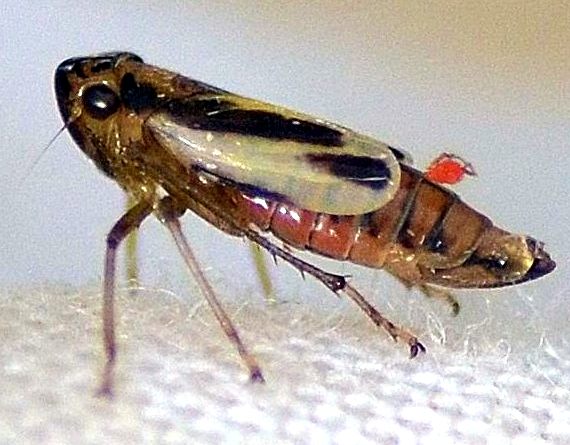
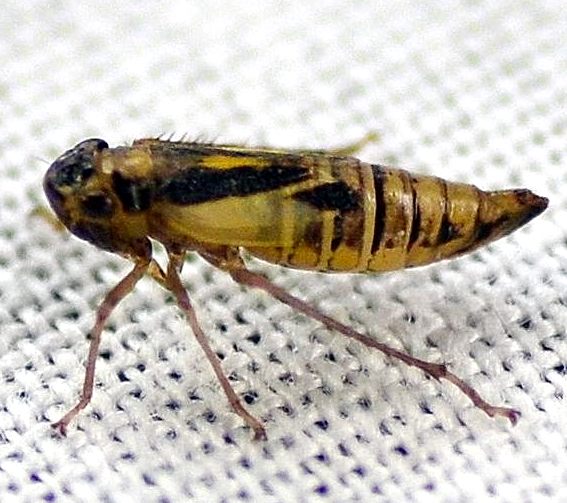
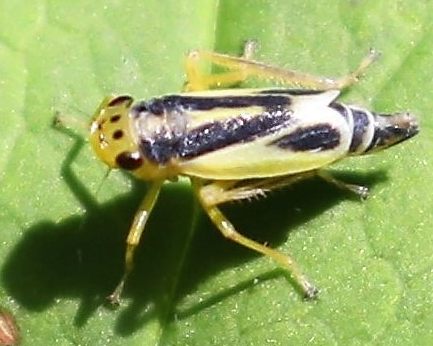
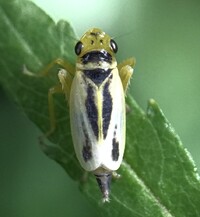
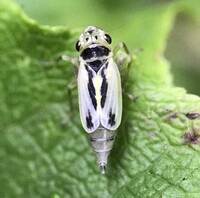
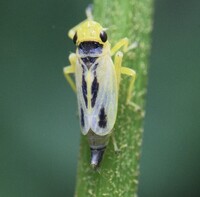
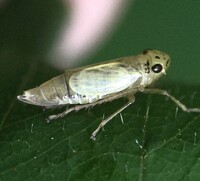
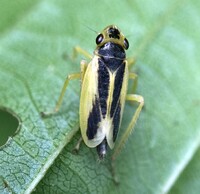
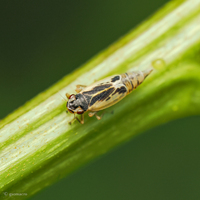
Males have moderately long wings that extend past the tip of the abdomen. The venter is orange-yellow, unmarked except for fuscous claws on the legs. The body is mostly pale brown, with two bold black spots on the head and fuscous speckling on the rest of the head, the middle of the pronotum, and the scutellum. Wings are ivory-white, sometimes with a yellow tint; there is a broad blackish-brown to black band that extends from the sides of the pronotum down the clavi and commissure of the wings before curving towards the wing tips. [NOTE: the black band (which is broken by the claval suture on each wing) does not reach all the way to the edge of the wings, helping distinguish this species from E. bellaustralis.] In males collected from Chestnut Bald, the entire pronotum was dark; see comments section below. Females have short, rounded wings with more than one abdominal segment exposed. Females are tan or orange, sometimes yellowish. They are patterned as in the males with dark, black but less extensive markings on the wings (the smaller black dash on the wings is noticeably larger in males) and pronotum, with some individuals with markings that are paler (more of a pale brown). In these paler individuals, there is a black mark on each side of the anterior margin of the pronotum. Adult males are 4.3-4.7 mm long, females are 5.0-6.0 mm. (Hamilton, 1983) |
| abundance |
A localized, mountaintop-inhabiting species found on several peaks in several counties in western North Carolina. There is a considerable gap between Yancey, Transylvania, and Macon counties, where this species has been recorded, so probably found at least between these two counties. However, the individuals in Transylvania and Macon counties could represent a separate species. See comments below. |
| comments |
This species is one of several Evacanthus found in North Carolina that have a similar color pattern: bellaustralis, chlamidatus, and ustanucha. See each species' respective page for how to identify each species. E. ustanucha is intermediate in coloration between the other two species, and all three species have identical genitalia; however, they are not variants of a single species since long series collected in different localities reveal little variation in the characters.
As is evident by the three species listed above, members of Evacanthus (outside of E. nigramericanus) in North Carolina have evolved into separate species according to geographic isolation, with mountain peaks serving as "sky islands" for this genus. Therefore, it seems possible/likely that the records of E. ustanucha from Transylvania and Macon counties could represent undescribed species due to the geographic isolation from the individuals on Mt. Mitchell. For the individuals collected on Chestnut Bald in Transylvania county, Hamilton (1983) notes that these specimens could represent a separate species, as suggested by the entirely dark pronotum in males. |
Species Photo Gallery for Evacanthus ustanucha No Common Name |
 | Photo by: Paul Scharf, B Bockhahn
Yancey Co.
Comment: Caught sweeping | 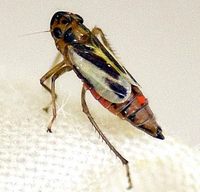 | Photo by: Paul Scharf, B Bockhahn
Yancey Co.
Comment: Caught sweeping |
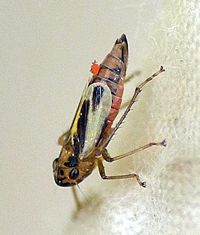 | Photo by: Paul Scharf, B Bockhahn
Yancey Co.
Comment: Caught sweeping | 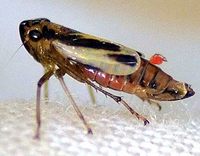 | Photo by: Paul Scharf, B Bockhahn
Yancey Co.
Comment: Caught sweeping |
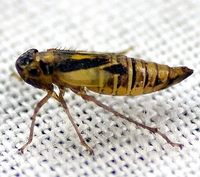 | Photo by: Paul Scharf, B Bockhahn
Yancey Co.
Comment: Attracted to Light | 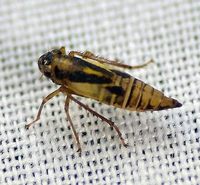 | Photo by: Paul Scharf, B Bockhahn
Yancey Co.
Comment: Attracted to Light |
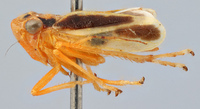 | Photo by: L.A. Kelton
Yancey Co.
Comment: This is the holotyperncoll. August 12, 1957rnimage from the Canadian National Collection | 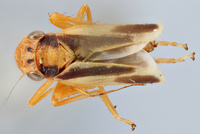 | Photo by: L.A. Kelton
Yancey Co.
Comment: This is the holotyperncoll. August 12, 1957rnimage from the Canadian National Collection |
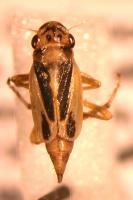 | Photo by: J. B. Sullivan
Yancey Co.
Comment: | 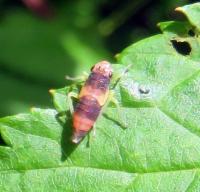 | Photo by: Lori Owenby
Yancey Co.
Comment: likely this species based on location |
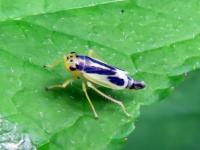 | Photo by: Lori Owenby
Yancey Co.
Comment: male | 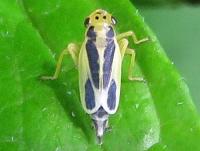 | Photo by: Lori Owenby
Yancey Co.
Comment: male |
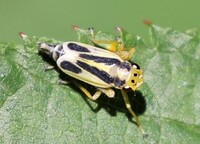 | Photo by: Rob Van Epps
Yancey Co.
Comment: Many seen on Pink Turtlehead and other plants near summit of Mount Mitchell. | 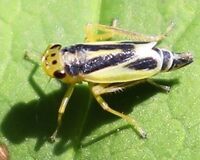 | Photo by: Rob Van Epps
Yancey Co.
Comment: Many seen on Pink Turtlehead and other plants near summit of Mount Mitchell. |
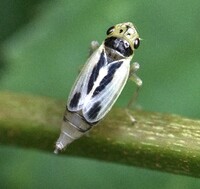 | Photo by: Ted Wilcox
Avery Co.
Comment: unid_leafhopper | 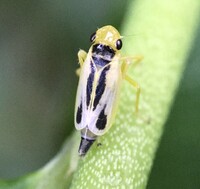 | Photo by: Ted Wilcox
Avery Co.
Comment: unid_leafhopper |
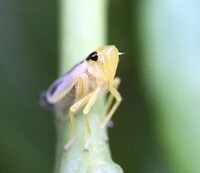 | Photo by: Ted Wilcox
Avery Co.
Comment: unid_leafhopper | 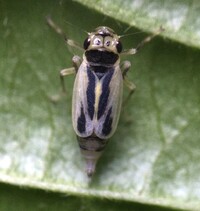 | Photo by: Ted Wilcox
Caldwell Co.
Comment: unid_leafhopper |
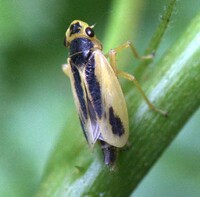 | Photo by: Ted Wilcox
Caldwell Co.
Comment: unid_leafhopper | 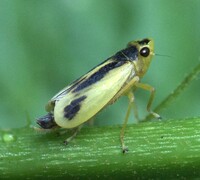 | Photo by: Ted Wilcox
Caldwell Co.
Comment: unid_leafhopper |
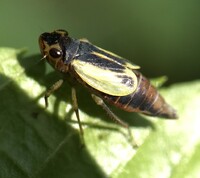 | Photo by: Ted Wilcox
Avery Co.
Comment: unid_leafhopper | 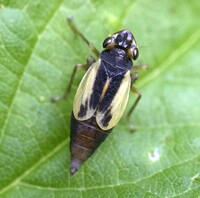 | Photo by: Ted Wilcox
Avery Co.
Comment: unid_leafhopper |
 | Photo by: Ted Wilcox
Avery Co.
Comment: unid_leafhopper | 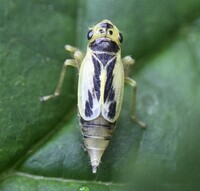 | Photo by: Ted Wilcox
Avery Co.
Comment: unid_leafhopper |
 | Photo by: Ted Wilcox
Avery Co.
Comment: unid_leafhopper | 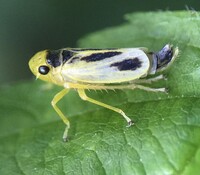 | Photo by: Ted Wilcox
Avery Co.
Comment: unid_leafhopper |
 | Photo by: Ted Wilcox
Avery Co.
Comment: unid_leafhopper | 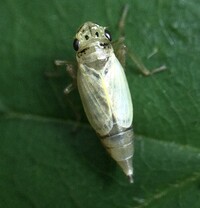 | Photo by: Ted Wilcox
Avery Co.
Comment: unid_leafhopper |
 | Photo by: Ted Wilcox
Avery Co.
Comment: unid_leafhopper | 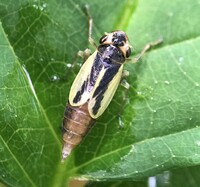 | Photo by: Ted Wilcox
Avery Co.
Comment: unid_leafhopper |
 | Photo by: Ted Wilcox
Avery Co.
Comment: unid_leafhopper | 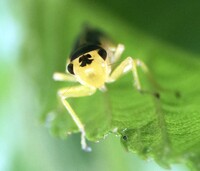 | Photo by: Ted Wilcox
Avery Co.
Comment: unid_leafhopper |
 | Photo by: Marilyn Westphal
Haywood Co.
Comment: |  | Photo by: Erin Price-Erwin
Haywood Co.
Comment: |
 | Photo by: Erin Price-Erwin
Haywood Co.
Comment: |

 »
»