Moths of North Carolina
Scientific Name:
Common Name:
Family (Alpha):
« Home »
View PDFArgyresthiidae Members: Argyresthia Members: 9 NC Records

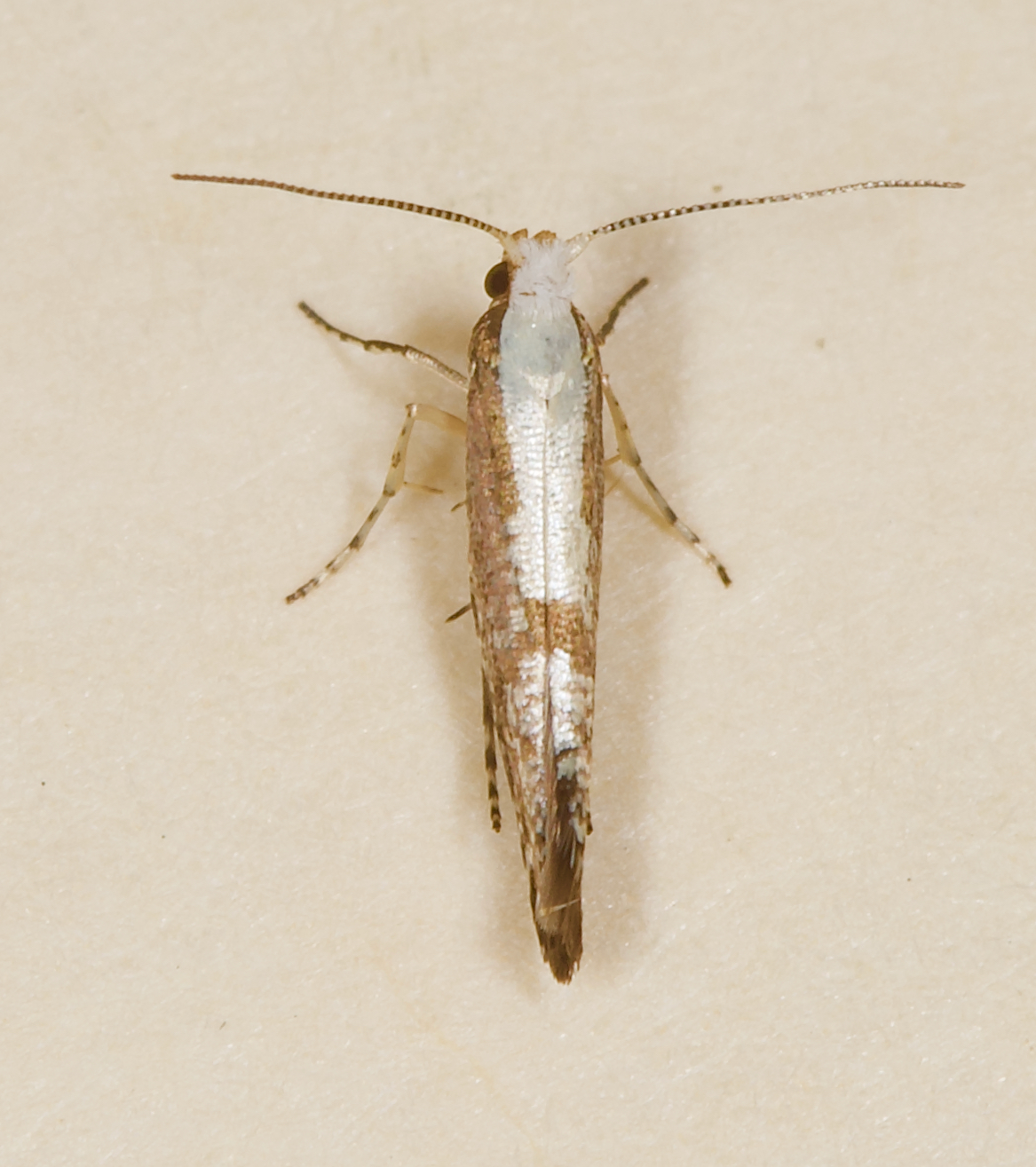
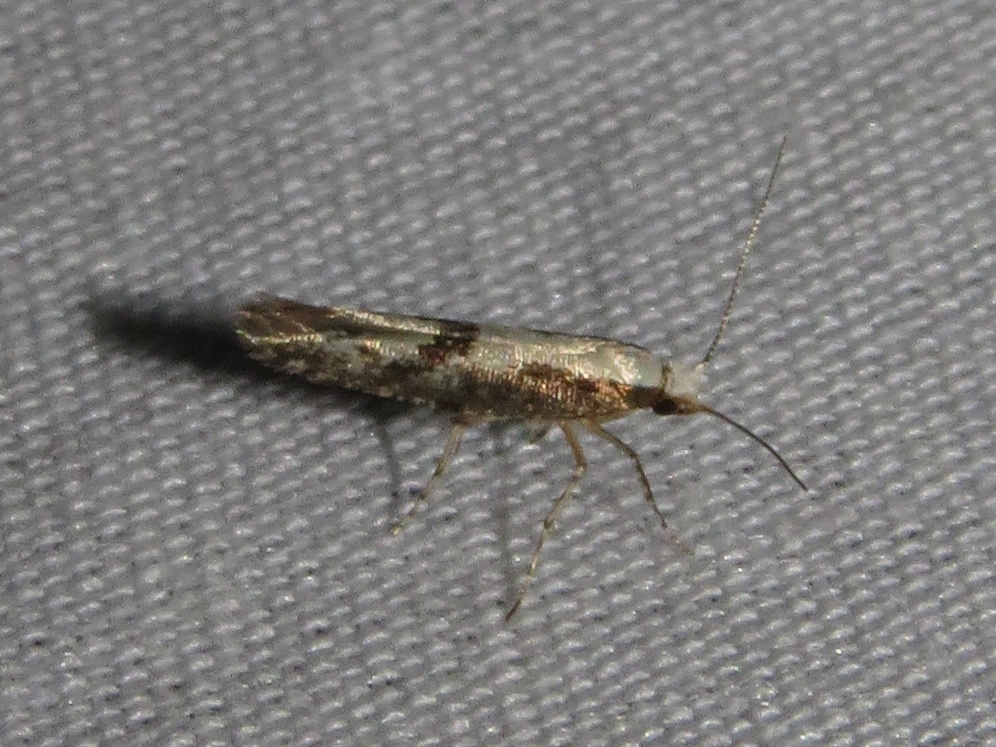
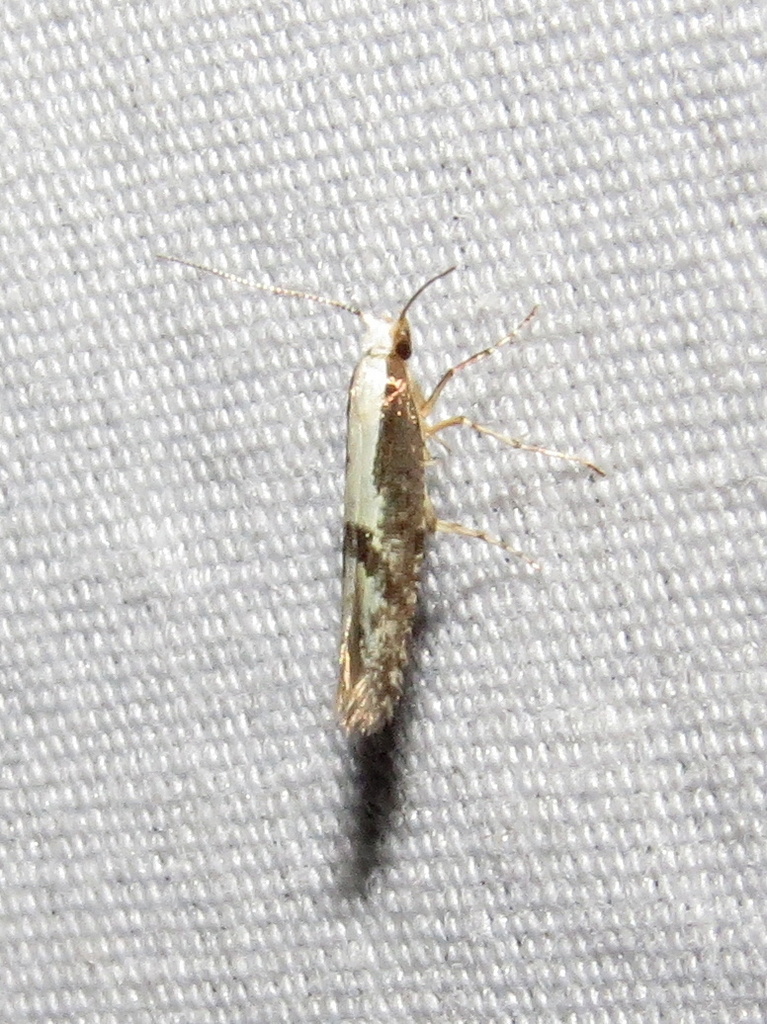
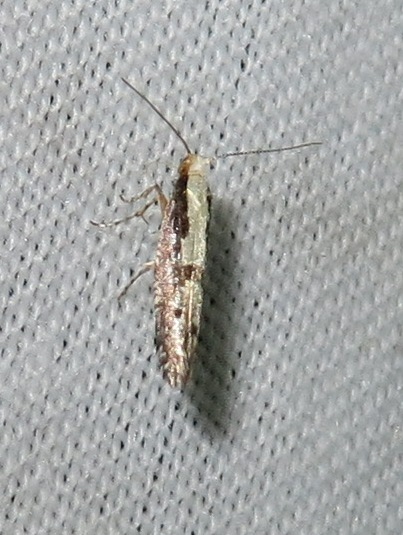
Argyresthia conjugella Zeller, 1839 - Apple Fruit Moth


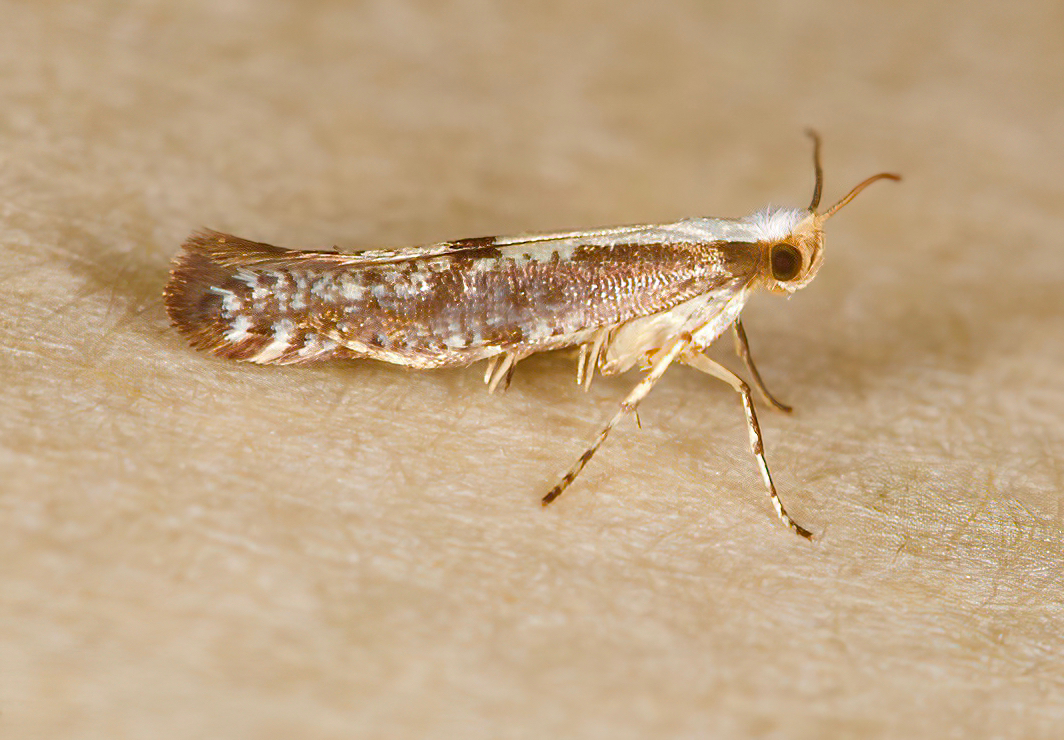
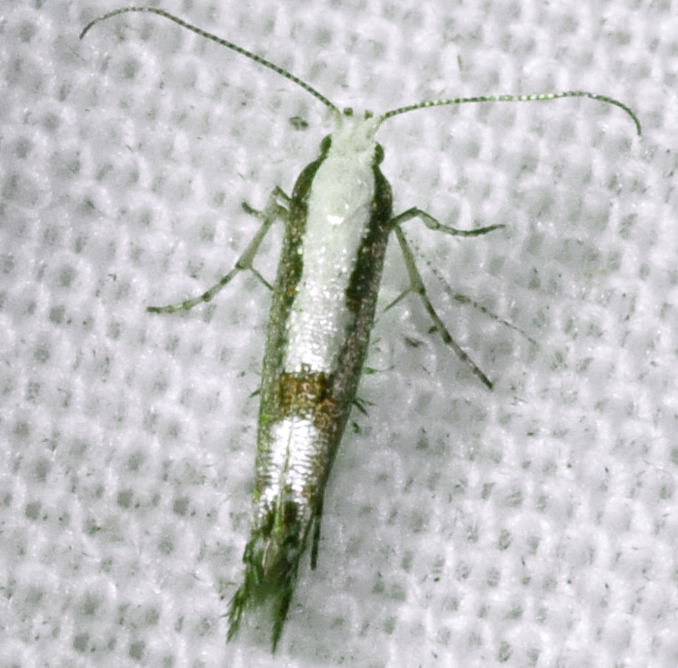
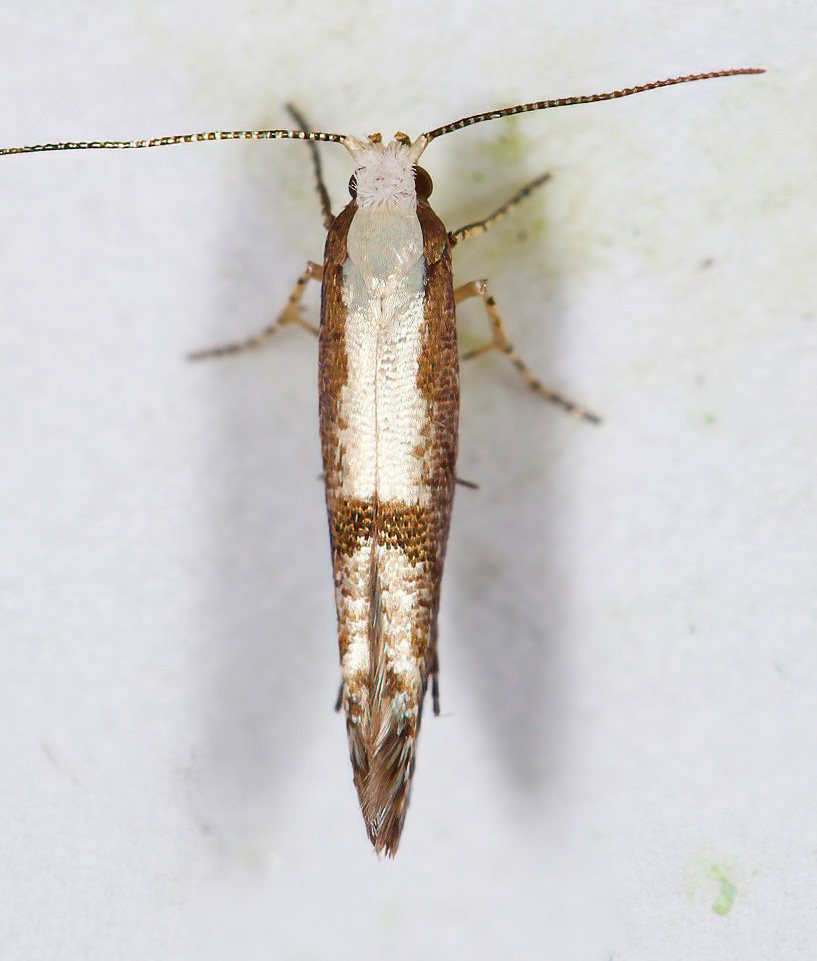
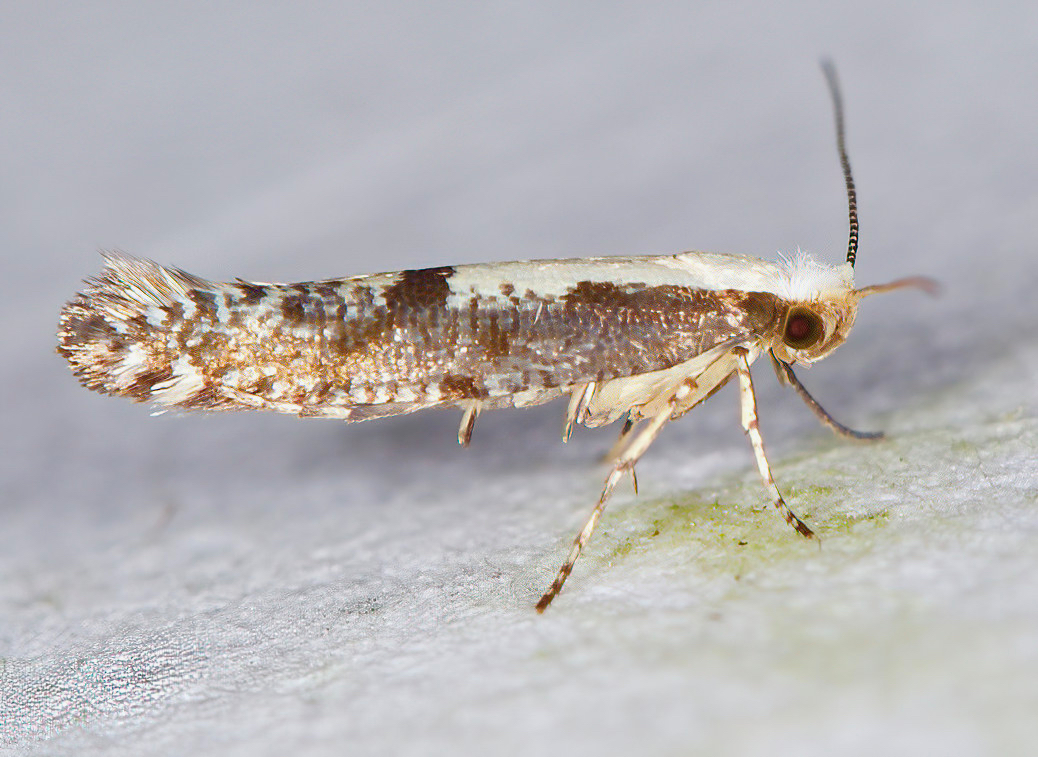
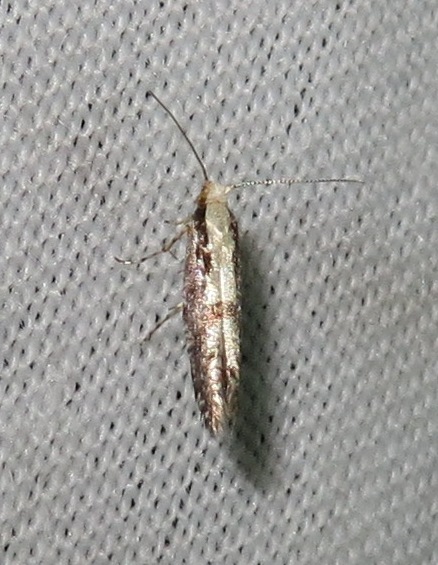
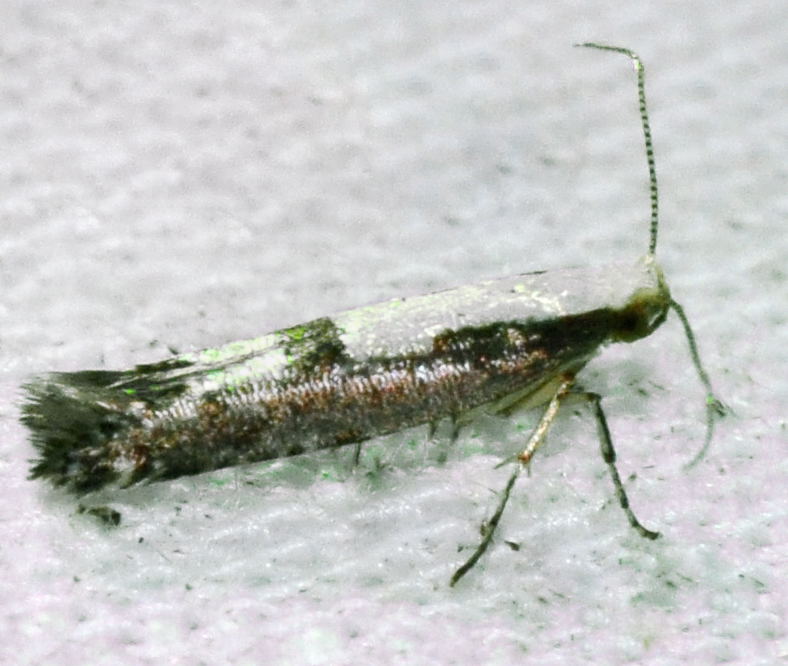
Argyresthia conjugellaArgyresthia conjugellaArgyresthia conjugellaArgyresthia conjugella
Taxonomy
Superfamily:
Yponomeutoidea
Family:
Argyresthiidae
P3 Number:
36a0075
MONA Number:
2449.00
Species Status: Argyresthia conjugella is native to Eurasia, but has been introduced into North America, Japan and other areas where it can be a major pest on commercial apples.
Identification
Field Guide Descriptions: Covell (1984)Online Resources: MPG, BugGuide, iNaturalist, Google, BAMONA, GBIF, BOLD                                                                                 
Adult Markings: Argyresthia conjugella is a small micromoth with the dorsum boldly marked with black and white. The head and thorax are white above and the antenna white with blackish annulations on the shaft. The forewing has a black basal stripe near the center of the wing that terminates at around one-fourth the wing length. Adjoining this is a wide, white costal band that gradually narrows before terminating at around three-fifths the wing length. The costal band is interrupted by a prominent, black, squarish mark at around one-half the wing length and just before the costal band terminates. The mark sometimes continues as a fainter, posterior-oblique band that terminates below the costa. The remainder of the wing is generally brownish, but speckled with scattered white spots. Other marks include a relatively large, white, sub-apical costal spot, and a series of 3-4 smaller white spots along the apical margin near the tornus. The terminal fringe is brownish with white specks, and the lanceolate hindwing is smoky-gray with a concolorous fringe.
Wingspan: 10-14 mm (Forbes, 1923).
Adult ID Requirements: Identifiable from good quality photos of unworn specimens.
Immatures and Development: The following is a summary of the life cycle, mostly from the E. H. Strickland Museum website, and based on several studies in Europe (e.g., Macdougall, 1926) and Japan. After mating, females in Europe lay eggs on the unripe fruit of Mountain Ash (Sorbus aucuparia) or Apple (Malus spp.) in June or July. They hatch in 6-14 days and the hatchlings immediately bore into the developing fruits. The larva slowly eats out most of the fruit, and, if feeding on Sorbus, may move to another fruit if the first is completely consumed. Infected fruits may redden prematurely and are often spun together. When feeding on apples, there can be several larvae in a single fruit. After feeding for around six to eight weeks or more, the fully grown larva descends to the ground on a silken thread and spins a dense silken cocoon within a second open-network cocoon. The cocoon is often spun just beneath the surface of the ground, in leaf litter, under bark or in a fallen fruit. The fully fed larva is around 7 mm long, and the head, prothoracic shield and anal plates are pale-brown. The whitish yellow body turns pink when the larva is full-grown. The pupae overwinter from September to May in northern climates. Baker (1972) reported that the larvae in the northeastern US bore in the fruits of mountain ash, shadbush, Crataegus, apple, plum, and cherry.
Larvae ID Requirements: Identifiable only through rearing to adulthood.
Distribution in North Carolina
Distribution: Argyresthia conjugella was introduced from Europe into North America in the late 1800's and is now broadly distributed across North America in areas with cool climates. The range includes much of southern Canada, including the Yukon Territory and British Columbia eastward to Nova Scotia and Prince Edward Island, and the Pacific Northwest and northern Rocky Mountains in the West. In the eastern US, the range extends from Maine and other New England states through the Appalachian region of Pennsylvania, West Virginia, Maryland and northern Virginia. Populations also occur in western North Carolina where they appear to be disjunct from the main range to the north. As of 2025, all of our records are from higher-elevation sites in the Blue Ridge.
County Map: Clicking on a county returns the records for the species in that county.
Argyresthia conjugellaAlamance Alexander Alleghany Anson Ashe Avery Beaufort Bertie Bladen Brunswick Buncombe Burke Cabarrus Caldwell Camden Carteret Caswell Catawba Chatham Cherokee Chowan Clay Cleveland Columbus Craven Cumberland Currituck Dare Davidson Davie Duplin Durham Edgecombe Forsyth Franklin Gaston Gates Graham Granville Greene Guilford Halifax Harnett Haywood Henderson Hertford Hoke Hyde Iredell Jackson Johnston Jones Lee Lenoir Lincoln Macon Madison Martin McDowell Mecklenburg Mitchell Montgomery Moore Nash New Hanover Northampton Onslow Orange Pamlico Pasquotank Pender Perquimans Person Pitt Polk Randolph Richmond Robeson Rockingham Rowan Rutherford Sampson Scotland Stanly Stokes Surry Swain Transylvania Tyrrell Union Vance Wake Warren Washington Watauga Wayne Wilkes Wilson Yadkin Yancey
Flight Dates:
High Mountains (HM) ≥ 4,000 ft.
Low Mountains (LM) < 4,000 ft.
Piedmont (Pd)
Coastal Plain (CP)

Click on graph to enlarge
Image showing flight dates by month for High Mountains greater than 4,000 feet, Low Mountains, Piedmont, and Coastal Plain: adults.
Flight Comments: Populations in North Carolina are univoltine, with a brief flight period. As of 2025, all of our records are from late-May to mid-June.
Habitats and Life History
Habitats: Local populations in North Carolina have been found in northern hardwood forests with forest edge habitat, Appalachian balds, and in high-elevations habitats with openings such as Mt. Mitchell State Park.
Larval Host Plants: The larvae specialize on members of the Rosaceae, with the reported hosts in North America including shadbush (Amelanchier), hawthorn (Crataegus), apple (Malus), cherries and plums (Prunus), pears (Pyrus), and mountain-ash (Sorbus) (Baker 1972, Forbes, 1923; Ferguson, 1975; Robinson et al., 2010). As of 2025, we do not have any feeding records in North Carolina. - View
Observation Methods: The adults are attracted to lights.
Wikipedia
See also Habitat Account for Montane Rosaceous Thickets
Status in North Carolina
Natural Heritage Program Status:
Natural Heritage Program Ranks: GNR SNA
State Protection: Has no legal protection, although permits are required to collect it on state parks and other public lands.
Comments: This species is introduced and is of no conservation concern.

 Photo Gallery for Argyresthia conjugella - Apple Fruit Moth

Photos: 11
Argyresthia conjugella
Recorded by: Jim Petranka and Becky Elkin on 2022-06-07
Madison Co.
Comment:
Argyresthia conjugella
Recorded by: Jim Petranka and Becky Elkin on 2022-06-07
Madison Co.
Comment:
Argyresthia conjugella
Recorded by: Jim Petranka and Becky Elkin on 2021-05-21
Madison Co.
Comment:
Argyresthia conjugella
Recorded by: Jim Petranka and Becky Elkin on 2021-05-21
Madison Co.
Comment:
Argyresthia conjugella
iNaturalist
Recorded by: loriannkayaker - Lori A Owenby on 2016-06-29
Yancey Co.
Comment: iNat record - https://www.inaturalist.org/observations/3626111***(c) Lori A Owenby, some rights reserved (CC BY-NC)| Public Positional Accuracy=53 m Elevation=6090.7 feet
Argyresthia conjugella
iNaturalist
Recorded by: edcoreyncdpr - Ed Corey on 2016-06-28
Yancey Co.
Comment: iNat record - https://www.inaturalist.org/observations/3584140***(c) Ed Corey, all rights reserved| Public Positional Accuracy=1138 m Elevation=6181.9 feet
Argyresthia conjugella
iNaturalist
Recorded by: edcoreyncdpr - Ed Corey on 2016-06-28
Yancey Co.
Comment: iNat record - https://www.inaturalist.org/observations/3584141***(c) Ed Corey, all rights reserved| Public Positional Accuracy=1138 m Elevation=6181.9 feet
Argyresthia conjugella
Recorded by: B. Bockhahn, P. Scharf, K. Kittelberger on 2015-06-18
Avery Co.
Comment:
Argyresthia conjugella
Recorded by: B. Bockhahn, P. Scharf, K. Kittelberger on 2015-06-18
Avery Co.
Comment:
Argyresthia conjugella
Recorded by: Kyle Kittelberger, Brian Bockhahn on 2014-06-08
Avery Co.
Comment:
Argyresthia conjugella
Recorded by: Kyle Kittelberger, Brian Bockhahn on 2014-06-08
Avery Co.
Comment:

Photos of Argyresthia conjugella from iNaturalist

Argyresthia conjugella
© edcoreyncdpr - Ed Corey - 2016-06-28 - Yancey Co.
iNat record
Argyresthia conjugella
© edcoreyncdpr - Ed Corey - 2016-06-28 - Yancey Co.
iNat record
Argyresthia conjugella
© loriannkayaker - Lori A Owenby - 2016-06-29 - Yancey Co.
iNat record