Moths of North Carolina
Scientific Name:
Common Name:
Family (Alpha):
« Home »
View PDFTortricidae Members: Cryptaspasma Members: 23 NC Records

Cryptaspasma bipenicilla Brown & Brown, 2004 - White-dotted Cryptaspasma


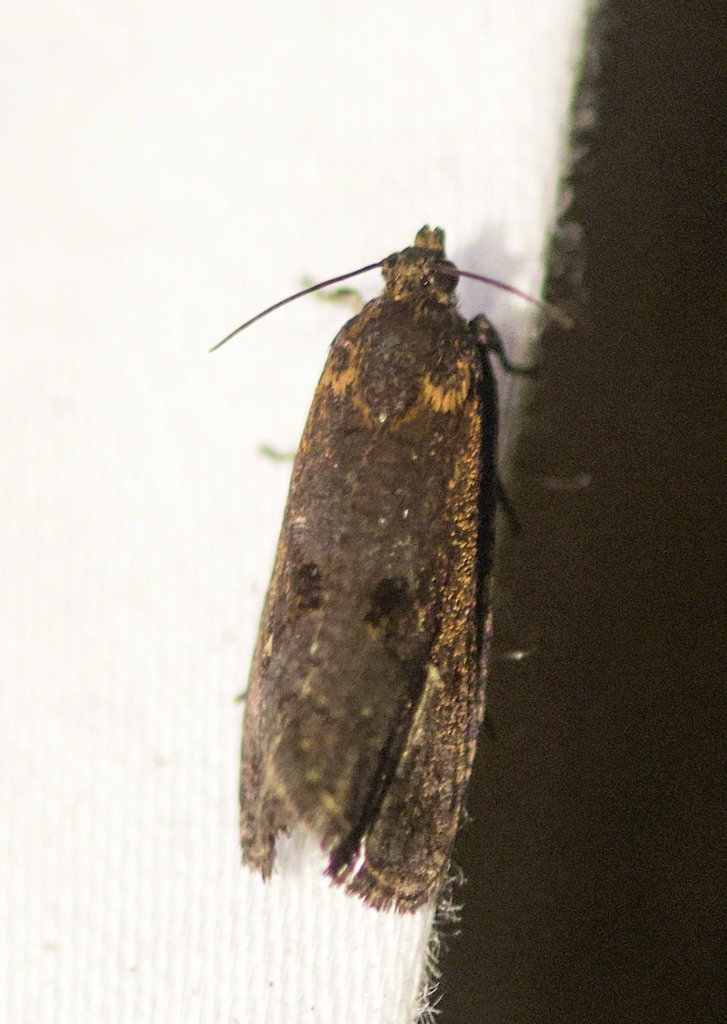
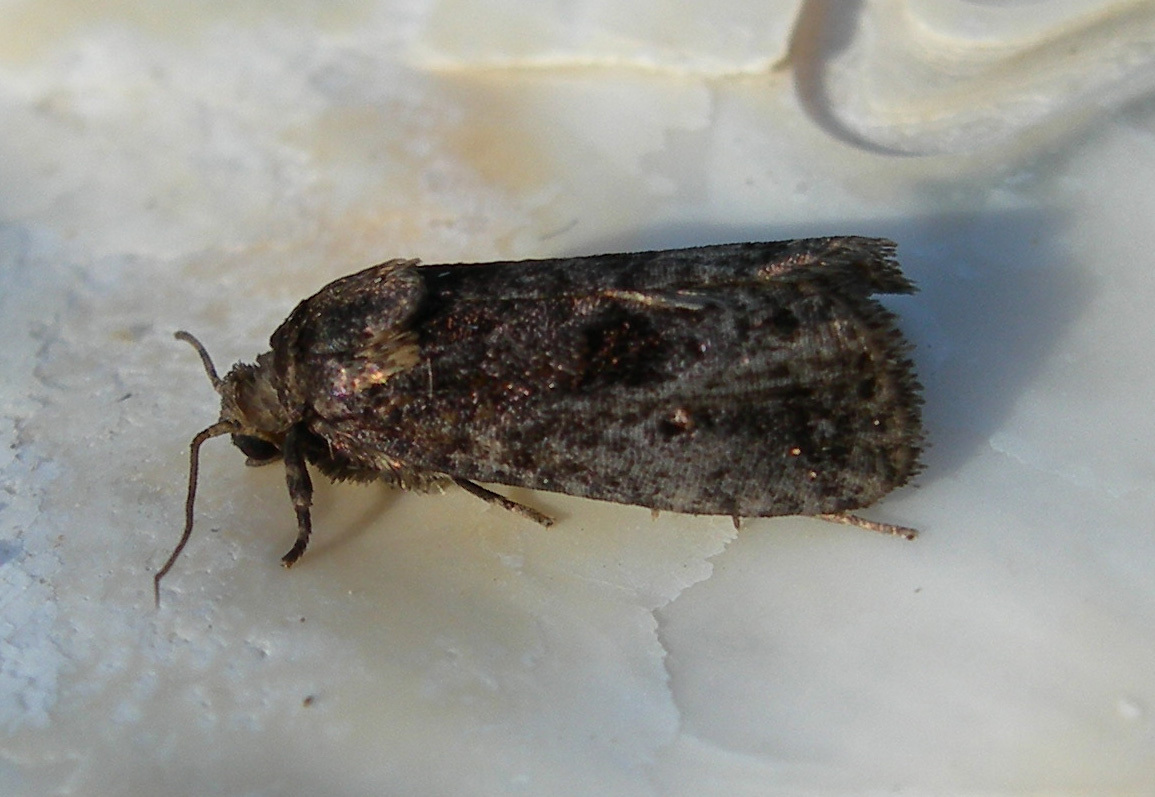
Cryptaspasma bipenicillaCryptaspasma bipenicillaCryptaspasma bipenicilla
Taxonomy
Superfamily:
Tortricoidea
Family:
Tortricidae
Subfamily:
Olethreutinae
Tribe:
Microcorsini
P3 Number:
51a0459
MONA Number:
2704.10
Identification
Field Guide Descriptions: Online Resources: MPG, BugGuide, iNaturalist, Google, BAMONA, GBIF, BOLDTechnical Description, Adults: Brown and Brown (2004)                                                                                 
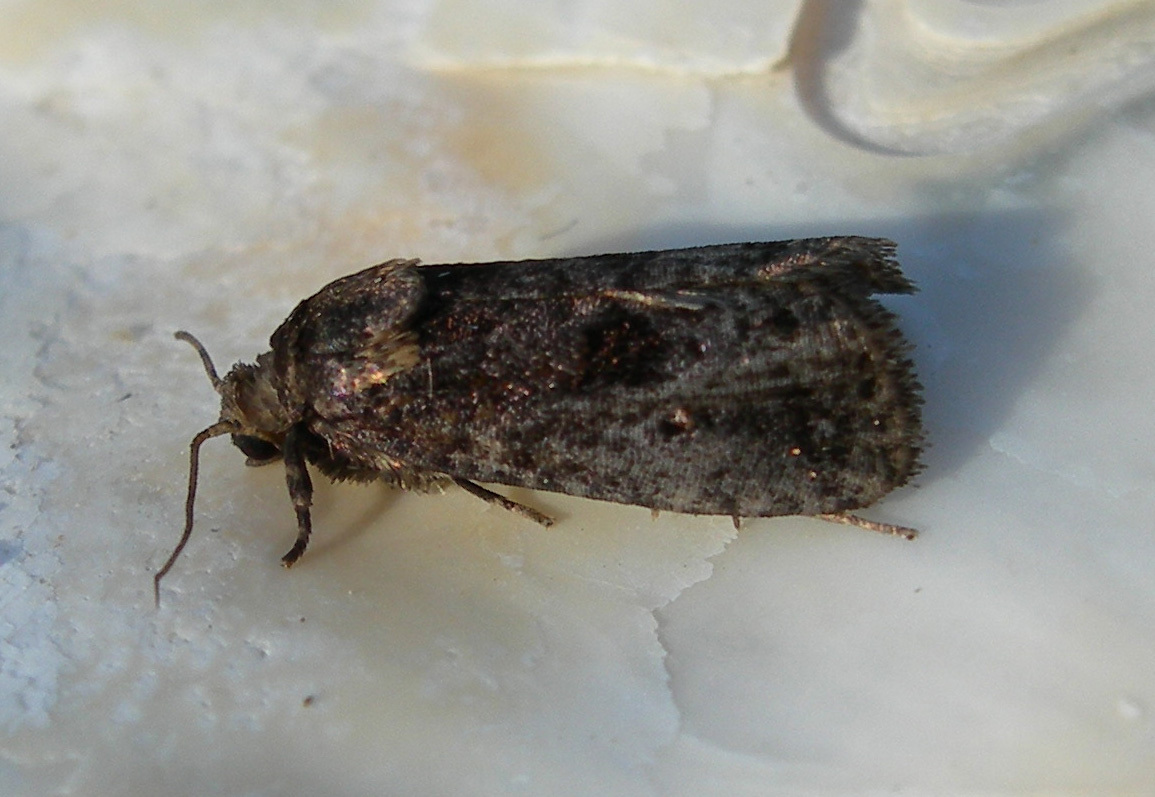
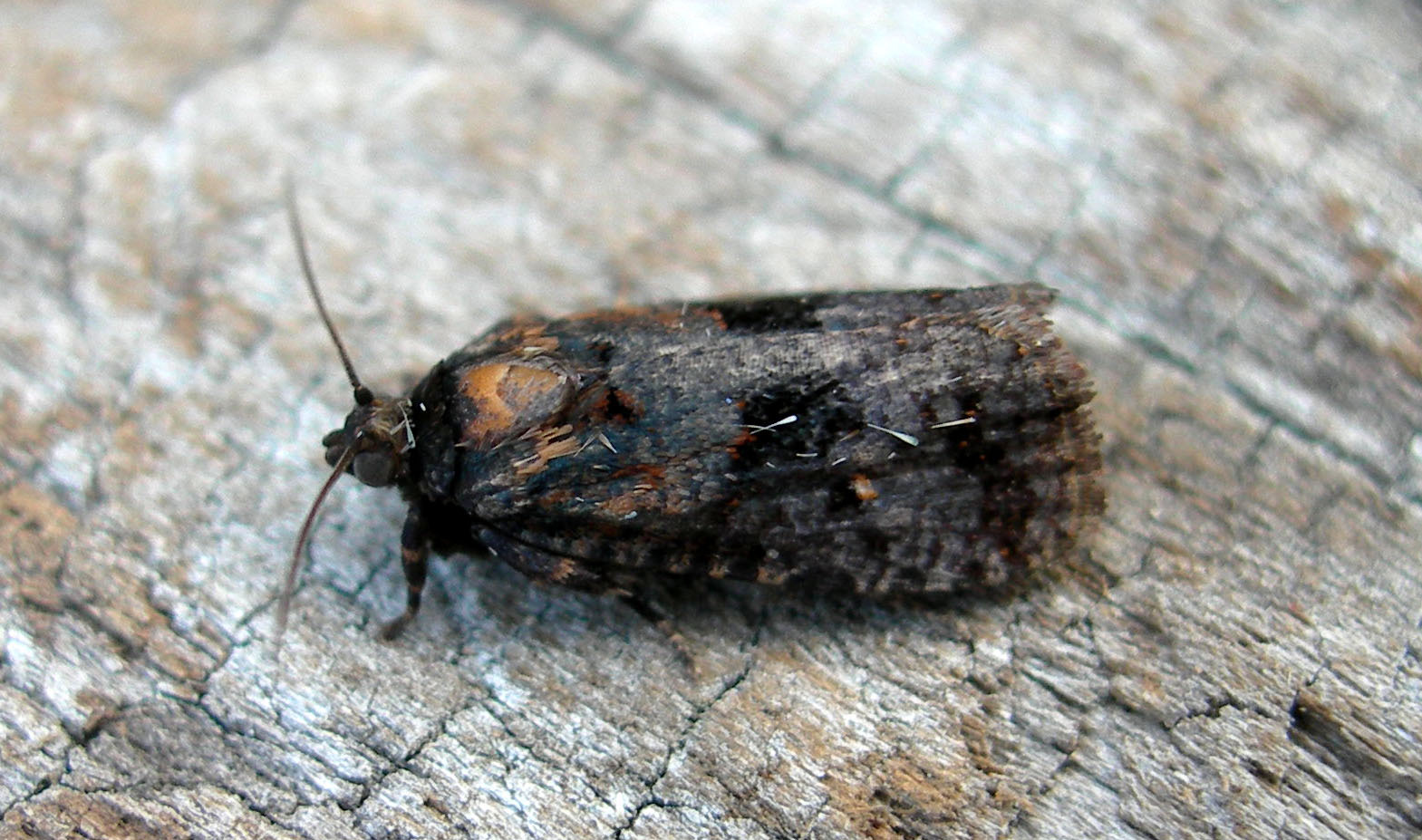
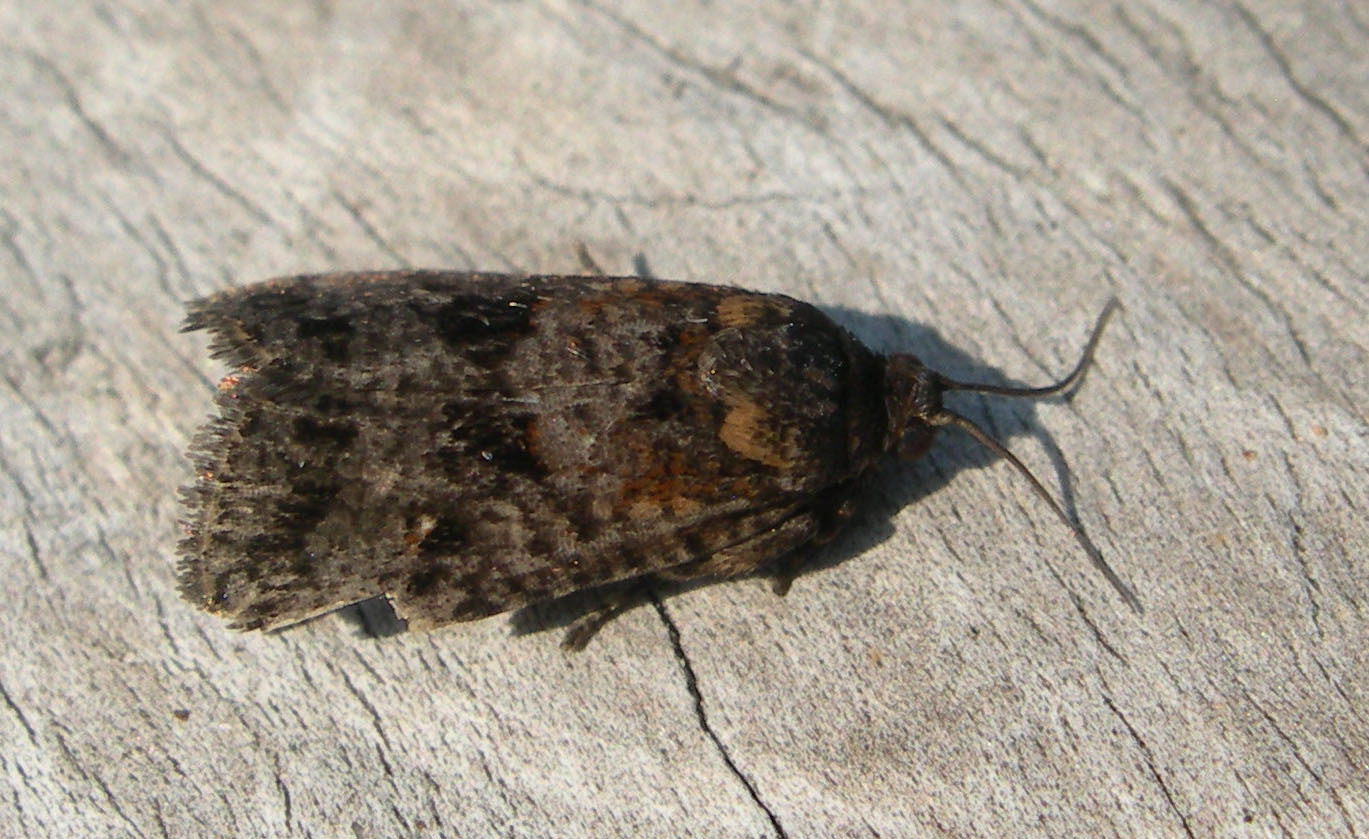
Adult Markings: Cryptaspasma bipenicilla is a mostly grayish-brown to brownish-gray moth, with a forewing that has a conspicuous white dot on the distal half of the forewing, and three rather vague, highly irregular, blackish transverse bands near the base, middle and end of the wing. The following description is based in part on that of Brown and Brown (1994). The frons is brown, while the labial palp is dark-brown, short and blunt. The brownish vertex is short and does not extend much above the eyes. The thorax is also brown and bordered on each side by a tegula that is brown with an orangish outer half.

The forewing ground is brown with scattered orange and pale-brown scales that produce a weakly striated or reticulated pattern. There are three rather vague, highly irregular, blackish transverse bands near the wing base, in the middle, and in the subterminal region that are variably expressed. The middle band is the most prominent, and often only expressed on the dorsal half. A small but conspicuous white dot that is often bordered with a few orange scales is present below the costa at around three-fifths the wing length from the base. The costa is lined with single or paired, short, pale-colored strigulae that are separated by dark-brown areas in between. The outer fringe is dark grayish-brown, and the hindwing varies from pale grayish-brown to creamy-gray. The foreleg has a large, conspicuous brush of scales on the anterior surface of the femur, and long scales on the ventral surface of the tibia. The midleg has long scales on the ventral surface of the femur and tibia, while the hindleg has long scales on the ventral surface of the femur, and the dorsal and ventral surfaces of the tibia.
Forewing Length: 6.5-10 mm (Brown and Brown, 2004).
Adult Structural Features: Brown and Brown (2004) has illustrations and descriptions of the male and female genitalia. Also, see genitalia images of North Carolina specimens below.
Genitalia and other structural photos
Adult ID Requirements: Identifiable from good quality photos of unworn specimens.
Immatures and Development: The larval life history is undocumented for populations in the southeastern US. Brown and Brown (2004) noted that there are feeding records for the larvae using the seeds of Avocado (Persea americana) and the fruits of Slugwood (Beilschmiedia pendula) on islands in the Caribbean.
Larvae ID Requirements: Identifiable only through rearing to adulthood.
Distribution in North Carolina
Distribution: Cryptaspasma bipenicilla is found in the southeastern Coastal Plain from southeastern Texas eastward to southern Florida, and northward to North Carolina. Scattered records are also known from Caribbean islands, including Cuba, Dominica, Dominican Republic, Jamaica and Puerto Rico. Brown and Brown (2004) surmised that this is a Caribbean species that may have expanded its range in the US since the early 1960's; however, they consider it to be native. As of 2025, all of our records are from the lower Coastal Plain.
County Map: Clicking on a county returns the records for the species in that county.
Cryptaspasma bipenicillaAlamance Alexander Alleghany Anson Ashe Avery Beaufort Bertie Bladen Brunswick Buncombe Burke Cabarrus Caldwell Camden Carteret Caswell Catawba Chatham Cherokee Chowan Clay Cleveland Columbus Craven Cumberland Currituck Dare Davidson Davie Duplin Durham Edgecombe Forsyth Franklin Gaston Gates Graham Granville Greene Guilford Halifax Harnett Haywood Henderson Hertford Hoke Hyde Iredell Jackson Johnston Jones Lee Lenoir Lincoln Macon Madison Martin McDowell Mecklenburg Mitchell Montgomery Moore Nash New Hanover Northampton Onslow Orange Pamlico Pasquotank Pender Perquimans Person Pitt Polk Randolph Richmond Robeson Rockingham Rowan Rutherford Sampson Scotland Stanly Stokes Surry Swain Transylvania Tyrrell Union Vance Wake Warren Washington Watauga Wayne Wilkes Wilson Yadkin Yancey
Flight Dates:
High Mountains (HM) ≥ 4,000 ft.
Low Mountains (LM) < 4,000 ft.
Piedmont (Pd)
Coastal Plain (CP)

Click on graph to enlarge
Image showing flight dates by month for High Mountains greater than 4,000 feet, Low Mountains, Piedmont, and Coastal Plain: adults.
Flight Comments: The adults fly year-round in Florida and Alabama, but are not active during the winter months elsewhere. As of 2025, our records extend from early-April to mid-October. Populations in North Carolina appear to produce two broods annually.
Habitats and Life History
Habitats: Many of our records are from pocosins or other wetland sites that support red bays, which are the likely hosts.
Larval Host Plants: As of 2025, the hosts in the US are undocumented. This species has been recorded feeding on the seeds of Avocado (Persea americana) and the fruits of Slugwood (Beilschmiedia pendula) in Puerto Rico and Cuba. Potential hosts in the southeastern United States include Upland Redbay (Persea borbonia [=Tamala borbonia]] and Swamp Redbay (Persea palustris [=Tamala palustris]]. (Austin et al., 2025). - View
Observation Methods: The adults are attracted to lights. Information is needed on host use and we encourage naturalist to search redbay fruits for larvae.
Wikipedia
See also Habitat Account for Redbay Shrublands
Status in North Carolina
Natural Heritage Program Status:
Natural Heritage Program Ranks: [GNR] S1S2
State Protection: Has no legal protection, although permits are required to collect it on state parks and other public lands.
Comments: This species reaches the northern limit of its range in North Carolina where it appears to be rare. As of 2025, we have only eight site records for the state.

 Photo Gallery for Cryptaspasma bipenicilla - White-dotted Cryptaspasma

Photos: 5
Cryptaspasma bipenicilla
Recorded by: R. Newman on 2025-05-06
Carteret Co.
Comment:
Cryptaspasma bipenicilla
Recorded by: R. Newman on 2024-08-27
Carteret Co.
Comment:
Cryptaspasma bipenicilla
iNaturalist
Recorded by: allenbryan on 2023-10-13
Hyde Co.
Comment: iNat record - https://www.inaturalist.org/observations/187511410***(c) allenbryan, some rights reserved (CC BY-NC)| Public Positional Accuracy=193 m Elevation=0 feet
Cryptaspasma bipenicilla
Recorded by: R. Newman on 2023-07-25
Carteret Co.
Comment:
Cryptaspasma bipenicilla
Recorded by: R. Newman on 2022-10-09
Carteret Co.
Comment:

Photos of Cryptaspasma bipenicilla from iNaturalist
Cryptaspasma bipenicilla
© allenbryan - 2023-10-13 - Hyde Co.
iNat record